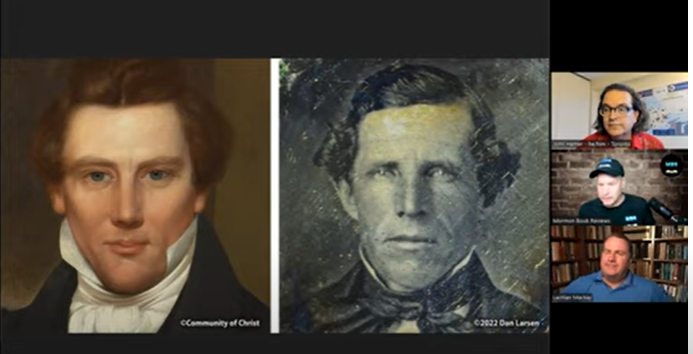
Ideas conquered long ago

Long ago, Joseph Smith and Oliver Cowdery conquered false claims that the Book of Mormon was fiction or that it came through a stone in a hat. But in recent years certain LDS scholars have resurfaced the false claims. To conquer them again, we have to return to what Joseph and Oliver taught.

Thursday, August 4, 2022

Intellectual curiosity and geography


People often ask how and why I changed my mind about Book of Mormon geography and the translation process. I've explained it a few times, but I'll summarize it again here regarding the geography and later regarding SITH (the stone-in-the-hat).

These are important issues because of the well-known impact they are having in creating the "faith crisis" epidemic that we're all familiar with. 

Basically, I've gone from accepting the New York Cumorah in the hemispheric model, to rejecting the New York Cumorah in favor of M2C (the limited geography Mesoamerican setting with Cumorah in southern Mexico), to re-accepting the New York Cumorah in a limited "Heartland" model that encompasses the eastern half of North America. In my view, the evidence for the Heartland model is compelling in several ways. 

First, the teachings of Joseph Smith and Oliver Cowdery are unambiguous and intentional, as are the teachings of their contemporaries and successors. While the M2C scholars rationalize away those teachings, anything can be rationalized away in the pursuit of bias confirmation, and the M2C arguments resort to the type of logical and factual fallacies we expect when driven by bias confirmation.

Second, the text of the Book of Mormon is vague about geography but specific enough to describe a variety of possible settings that incorporate the New York Cumorah.

Third, relevant sciences of archaeology, anthropology, geology, and geography corroborate many of the models based on the New York Cumorah.

Fourth, the refusal by M2C scholars to engage in serious, respectful dialog about the Heartland model, their continuing misrepresentations and even personal antipathy, and their ongoing efforts to censor the teachings of the prophets argues strongly against the validity of their theories. 

I'm happy for people to believe whatever they want. I just oppose the actions of LDS intellectuals who use their positions of power and influence to denigrate the beliefs of others and set up impediments for everyone, including other Latter-day Saints, to make informed decisions about these topics. 
______

When I was a young Latter-day Saint, we were taught that the Book of Mormon took place over the entire western hemisphere, from Chile to Canada. This was the Orson Pratt model that he outlined in his footnotes in the 1879 Book of Mormon, although he distinguished between fact (Cumorah in New York) and theory (Lehi landing in Chile, Zarahemla in Colombia, etc.). 

I had a seminary teacher tell me that all the Native Americans were descended from Lehi and that the idea these people crossed the Bering Strait was a lie. 

Then, when I went to BYU, I had a change in paradigm when I took a class from John Sorenson, who taught M2C (the limited geography model based in Mesoamerica that also teaches Cumorah is in southern Mexico and the "Cumorah" in New York was a false speculation by early Latter-day Saints). FARMS also taught M2C, claiming there was all kinds of evidence coming out to validate the Mesoamerican setting. I attended the conferences, read the newsletters, etc. I trusted Jack Welch, John Sorenson, Dan Peterson, etc. because I figured they knew a lot more about this than I did and, given the information they provided, it made sense.

Life (family, career, etc.) intervened and I didn't spend a lot of time assessing M2C for many years. But after visiting Mesoamerica a few times, I found the M2C theory didn't align with reality on the ground. In addition, many people I knew were leaving the Church, including former missionary companions, family members, and friends, mostly because of disbelief in the Book of Mormon.

I had a second change in paradigm several years ago when a mutual friend introduced me to Rod Meldrum, who told me about the Heartland approach to geography/historicity. Naturally, I did my "due diligence" and read what FAIRLDS, BMAF, and others had to say. I was surprised at how antagonistic the M2C scholars were toward the Heartland ideas. Their arrogance led me to further investigation. 

I went on a tour with Rod  and Wayne May. The sites and museums in Ohio are full of artifacts that fit the Book of Mormon better than what I'd seen in Mesoamerica. 

Returning to the M2C scholars, their arguments relied primarily on the 1842 Times and Seasons articles, which they claimed were written by Joseph Smith. The M2C scholars said Joseph didn't know much about the Book of Mormon or the Nephites, but he learned about them from the Stephens and Catherwood books.  

When I went back through Sorenson's work, such as Mormon's Codex, it soon became apparent that the whole thing is transparent bias confirmation. The M2C scholars to this day are trying to validate and corroborate what they think Joseph taught, even though they had to reject the New York Cumorah and rationalize away other statements Joseph actually made. 

I started pulling on the M2C thread and its components unraveled, starting with the Times and Seasons articles, then the M2C interpretation of the text of the Book of Mormon, then the M2C rejection of the New York Cumorah, and so forth. 

I wrote a few books, articles and blogs about M2C and why people should reconsider M2C and look at the Heartland alternative.

The reactions have been fascinating. The M2C scholars turned out to be incredibly closed-minded and self-satisfied, while the "Heartlanders" have been open-minded and eager to learn. It's the exact opposite of what we ordinary people might think, because intellectuals often tout their supposed open-mindedness and fairness.

There are exceptions from both sides, of course, but overall, the M2C scholars continue to refuse to engage the Heartland ideas seriously while also refusing to address the problems with M2C.

Next I'll discuss the SITH saga.


Friday, July 29, 2022

Structural stupidity

In an article in Atlantic, Jonathan Haidt observes the disintegration of society because of social media. He explains the problem of "Structural Stupidity" that arises when a consensus becomes immune from, and impervious to, contrary views, even from within the community.

It's the opposite of Joseph Smith's observation that "by proving contraries, truth is made manifest.” https://www.josephsmithpapers.org/paper-summary/letter-to-israel-daniel-rupp-5-june-1844/1 

Haidt predictably places his thumb firmly on the Left side of the scale, justifying and rationalizing the themes of the political left, but his description of the problem is useful and relevant nonetheless.

Our M2C and SITH citation cartels have created structural stupidity in much the way that Haidt describes here.

Structural Stupidity

Since the tower [of the metaphorical Babel] fell, debates of all kinds have grown more and more confused. The most pervasive obstacle to good thinking is confirmation bias, which refers to the human tendency to search only for evidence that confirms our preferred beliefs. Even before the advent of social media, search engines were supercharging confirmation bias, making it far easier for people to find evidence for absurd beliefs and conspiracy theories, such as that the Earth is flat and that the U.S. government staged the 9/11 attacks. But social media made things much worse.

The most reliable cure for confirmation bias is interaction with people who don’t share your beliefs. They confront you with counterevidence and counterargument. John Stuart Mill said, “He who knows only his own side of the case, knows little of that,” and he urged us to seek out conflicting views “from persons who actually believe them.” People who think differently and are willing to speak up if they disagree with you make you smarter, almost as if they are extensions of your own brain. People who try to silence or intimidate their critics make themselves stupider, almost as if they are shooting darts into their own brain....

So what happens when an institution is not well maintained and internal disagreement ceases, either because its people have become ideologically uniform or because they have become afraid to dissent?

This, I believe, is what happened to many of America’s key institutions in the mid-to-late 2010s. They got stupider en masse because social media instilled in their members a chronic fear of getting darted. ... 

But when an institution punishes internal dissent, it shoots darts into its own brain....

American politics is getting ever more ridiculous and dysfunctional not because Americans are getting less intelligent. The problem is structural. Thanks to enhanced-virality social media, dissent is punished within many of our institutions, which means that bad ideas get elevated into official policy. ...

Depression makes people less likely to want to engage with new people, ideas, and experiences. Anxiety makes new things seem more threatening. As these conditions have risen and as the lessons on nuanced social behavior learned through free play have been delayed, tolerance for diverse viewpoints and the ability to work out disputes have diminished among many young people. For example, university communities that could tolerate a range of speakers as recently as 2010 arguably began to lose that ability in subsequent years, as Gen Z began to arrive on campus. Attempts to disinvite visiting speakers rose. Students did not just say that they disagreed with visiting speakers; some said that those lectures would be dangerous, emotionally devastating, a form of violence. Because rates of teen depression and anxiety have continued to rise into the 2020s, we should expect these views to continue in the generations to follow, and indeed to become more severe.


https://www.theatlantic.com/magazine/archive/2022/05/social-media-democracy-trust-babel/629369/


The end

Tuesday, July 26, 2022

3 Nephi and the New Madrid earthquakes

From time to time, I still hear about M2Cers who claim the Book of Mormon describes volcanoes. A basic premise of M2C is that volcanoes mean the events had to take place in Mesoamerica and could not have taken place in the Midwestern U.S. where there are no volcanoes.

While I'm happy for people to believe whatever they want, I encourage people to make informed decisions. 

The first obvious problem with that argument is the text never mentions volcanoes. The M2Cers "see" volcanoes in the text because they have their own translation that lets them redefine terms to fit their theories about geography.

Another obvious problem with the M2C argument is their assumption that the destruction described in 3 Nephi could not have happened in the Midwest. 

Maybe in Utah people don't know much about the history and geology of the Midwest, but they can learn about it in this video about the New Madrid earthquakes in 1811-12.


(click to enlarge the screen captures below)


Monday, July 25, 2022

Read the books they want to ban

"Read the books they want to ban."

@naval
[Note: I originally posted this before I finished the point because I had an early tee-time. After playing golf, tennis, pool, etc., I realized I needed to add the balance of the content.]
I'm applying Naval's tweet to the LDS context. Some LDS intellectuals want the Latter-day Saints to read only their own work. They lack confidence in the viability of their own theories and dogma.
By contrast, I want people to compare multiple working hypotheses.
I encourage people to read what the M2C and SITH citation cartels publish because I encourage people to make informed decisions. Definitely, read Mormon's Codex, From Darkness Unto Light, the Interpreter articles, the Kno-Whys on Book of Mormon Central, the entries on FAIRLDS.org, etc.
But notice that the SITH sayers don't want you to read A Man that Can Translate or Infinite Goodness.
The M2Cers don't want you to read Between these Hills, Letter VII, Whatever Happened to the Golden Plates?, or even The Lost City of Zarahemla.
That's why I say, read the works the M2C/SITH citation cartel want to ban.

Friday, July 22, 2022

Thursday, July 21, 2022

Answering My Gospel Questions class

I know you readers are all eager for the next part of the series on From Darkness Unto Light (and it's awesome), but I'm delaying it by a day because the new Religion 280 class has been in the news a bit. I mentioned it before. Here are some links.

 https://www.sltrib.com/religion/2022/07/21/latest-mormon-land-class/

and

https://newsroom.churchofjesuschrist.org/article/new-institute-class-teaches-young-adults-how-to-find-answers-to-their-gospel-questions

This course is another very positive development for the establishment of Zion.

Here's a link to the teacher material:

https://www.churchofjesuschrist.org/study/manual/answering-my-gospel-questions-teacher-material?lang=eng

I'd like to see this course added to the Self Reliance program along with the Emotional Resilience course, which every Latter-day Saint should take.

This class, like the Emotional Resilience class, will elevate the Latter-day Saints who take it above the logical and factual thinking errors we see among both our LDS apologists and our critics.

_____

A good example is the section "Microtraining 3, How to Assess the Reliability of Sources."

I wish every Latter-day Saint would read and re-read this section. It articulates exactly what I've advocated ever since I started this blog. Like the introduction to the Gospel Topics Essays, this microtraining is the antithesis of the M2C/SITH citation cartel's approach.

While people are free to believe whatever they want, it's easy to assess the relative reliability of the teachings of the prophets vs. the teachings of the scholars.

No scholar alive today was present when Joseph and Oliver translated the plates, when they received the Priesthood, etc. 

Section 2 below suggests we ask: "How closely connected is the author to the events being described? When a source addresses something from Church history, ask yourself how far removed the source is from the event it is discussing. Stories based on second- or thirdhand accounts are often less reliable." 

Let's see how well SITH and M2C survive this guidance.

We have Joseph and Oliver both explaining, multiple times, that Joseph translated the record with the Urim and Thummim that came with the plates. Yet our modern scholars teach that Joseph and Oliver misled everyone because they, the modern scholars, know that Joseph actually didn't use the plates or the Urim and Thummim but instead Joseph merely read words that appeared in the stone in the hat (SITH). 

We have Oliver explaining it was a fact that Cumorah of Mormon 6:6 is in New York, we have Joseph's mother explaining that Moroni identified the hill as Cumorah the first time he met Joseph, we have David Whitmer explaining that one of the Nephites took the abridged plates from Harmony to Cumorah, etc., but our modern scholars reject all of that. Why? Because they teach that Joseph and Oliver were ignorant speculators who misled everyone until they, our modern scholars, figured out that there were "two Cumorahs" and that the real Cumorah is somewhere in southern Mexico.

Seriously, how more obvious could this be?

In section 3 below, we read this: "Does the author intentionally ignore available evidence in order to mislead? Some authors deliberately omit important facts and ignore critical evidence to support their particular point of view."

To promote both SITH and M2C, our modern scholars deliberately omit important facts and ignore critical evidence to support their points of view. We've seen how the book From Darkness Unto Light does this, and the next installment will provide more examples. The citation cartel consistently omits evidence that contradicts M2C and SITH. Even the Gospel Topics Essay on translation omits what Joseph and Oliver said about the translation in favor of the theories of the scholars who wrote the essay. 

_____

As the principles of this new course permeate LDS culture, we will see a lot of new approaches to Church history and other topics. More and more Latter-day Saints will see that the evidence supports and corroborates the teachings of the prophets.

Who knows? Maybe even our scholars will someday value the teachings of the prophets over their own theories.

Patrick Mason was quoted in the article. He made a good point, but it's a bit self-congratulatory, seeing that he's a professional historian himself. 

Sources are key. Patrick Mason, head of Mormon history and culture at Utah State University, recently told The Salt Lake Tribune that those researching church history, for instance, should stick with primary sources and the work of professional historians.

“Go look at the original stuff and make your own judgments,” he said. “Don’t just rely on what somebody on the internet happened to say about it.”

To the extent professional historians provide access to primary sources, they're awesome. But to the extent they present their opinions as fact, they're counterproductive. I discussed a significant example here: 

https://www.academia.edu/67756647/Agenda_driven_editorial_content_in_the_Joseph_Smith_Papers

_____

Here's the link to microtraining 3.

https://www.churchofjesuschrist.org/study/manual/answering-my-gospel-questions-teacher-material/4-appendix-a/19-microtraining-3?lang=eng

How to Assess the Reliability of Sources

Define

Display the following statement by President Dallin H. Oaks of the First Presidency:

We live in a time of greatly expanded and disseminated information. But not all of this information is true. We need to be cautious as we seek truth and choose sources for that search. (Dallin H. Oaks, “Truth and the Plan,” Ensign or Liahona, Nov. 2018, 25)

Model

Provide students with the following handout, and discuss how these questions can help us identify reliable sources.

Questions for Evaluating Sources

Answering My Gospel Questions—Microtraining 3: How to Assess the Reliability of Sources

  1. What are the qualifications, intentions, and possible biases of the author?

    President Dallin H. Oaks of the First Presidency taught that we should “be cautious about the motivation of the one who provides information. … Our personal decisions should be based on information from sources that are qualified on the subject and free from selfish motivations” (Dallin H. Oaks, “Truth and the Plan," Ensign or Liahona, Nov. 2018, 25).

  2. How closely connected is the author to the events being described?

    When a source addresses something from Church history, ask yourself how far removed the source is from the event it is discussing. Stories based on second- or thirdhand accounts are often less reliable.

  3. Does the author intentionally ignore available evidence in order to mislead?

    Some authors deliberately omit important facts and ignore critical evidence to support their particular point of view.

  4. Are the teachings and events addressed in this source presented in the proper context of their time, place, and circumstance?

    Some teachings and historical events can become confusing when they are taken out of the context of their time and place. Historical context also includes other events happening at the time (such as wars, economic crises, and social and political movements) and the culture and demographics of a given time and setting.

  5. Are the teachings and events supported by additional reliable sources?

    Support from other reliable sources helps establish the accuracy of doctrine and historical events.


Tuesday, July 19, 2022

From Darkness Unto Light and Mormonism Unvailed part 1

In this post and the next one, we'll discuss the way the book From Darkness Unto Light handles the book Mormonism Unvailed. 

The book quotes or cites Mormonism Unvailed 31 times. We'll look at those references in part 2, but today let's look at how Joseph and Oliver dealt with Mormonism Unvailed. 

[BTW, an editorial note: I fixed the formatting of the post about the Interpreter on TikTok: 

https://www.bookofmormoncentralamerica.com/2022/07/the-interpreter-on-tiktok.html]

_____

The 1834 book Mormonism Unvailed made a big impact on the Church. It set out the Spalding theory that dominated the national media in the 1800s. It also spelled out the "stone-in-the-hat" theory (SITH) which modern LDS intellectuals have embraced.

Joseph Smith and Oliver Cowdery responded to Mormonism Unvailed in a series of eight essays about Church history, published as letters in the Messenger and Advocate in 1834-5. Joseph had his scribes copy these essays into his own history as part of his life story. An excerpt from Letter I is found in the Pearl of Great Price. Letter VII explains that it is a fact that the Hill Cumorah in western New York is the same Hill Cumorah of Mormon 6:6.

The essays were not Joseph's only response to Mormonism Unvailed and related anti-Mormon literature. He wrote a serialized letter to "To the Elders of the Church of the Latter Day Saints" that was published in the Messenger and Advocate in September, November and December 1835.  In the November issue, he explained that "I have been drawn into this course of proceeding, by persecution, that is brought upon us from false rumor, and misrepresentations concerning my sentiments." (Messenger and Advocate II.2:209 ¶2)

Before reading the excerpt from the December issue below, think compare Joseph's treatment of Mormonism Unvailed with the way our modern LDS apologists and historians have embraced that book. 

Joseph used phrases such as "the enemy of righteousness," "pitchfork of lies," "adversary of truth," and "cloud of darkness."

Behold, then, is not this the kingdom of heaven that is raising its head in the last days, in the majesty of its God; even the church of the Latter day saints,—like an impenetrable, immovable rock in the midst of the mighty deep, exposed storms and tempests of satan, but has, thus far, remained steadfast and is still braving the mountain waves of opposition, which are driven by the tempestuous winds of sinking crafts, have and are still dashing with tremendous foam, across its triumphing brow, urged onward with redoubled fury by the enemy of righteousness, with his pitchfork of lies, as you will see fairly represented in a cut, contained in Mr. Howe’s “Mormonism Unveiled?”

And we hope that this adversary of truth will continue to stir up the sink of iniquity, that people may the more readily discern between the righteous and wicked. We also would notice one of the modern sons of Seeva, who would fain have made people believe that he could cast out devils by a certain pamphlet (viz. the “Millennial Harbinger,”) that went the rounds through our country, who felt so fully authorized to brand Jo Smith, with the appellation of Elymus the sorcerer, and to say with Paul, O full of all subtilty and all mischief, thou child of the devil, thou enemy of all righteousness, wilt thou not cease to pervert the right ways of the Lord! We would reply to this gentleman—Paul we know, and Christ we know, but who are ye? And with the best of feelings, we would say to him, in the language of Paul to those who said they were John’s disciples, but had not so much as heard there was a Holy Ghost, to repent and be baptized for the remission of sins by those who have legal authority, and under their hands you shall receive the Holy Ghost, according to the scriptures.

... We might invite the gentleman to a public investigation of these matters; yea, and we do challenge him to an investigation upon any or all principles wherein he feel opposed to us, in public or in private.

We might farther say that, we could introduce him to “Mormonism Unveiled.” Also to the right honorable Doct. P. Hurlburt, who is the legitimate author of the same, who is not so much a doctor of physic, as of falsehood, or by name. We could also give him an introduction to the reverend Mr. Howe, the illegitimate author of “Mormonism Unveiled,” in order to give currency to the publication, as Mr. Hurlburt, about this time, was bound over to court, for threatening life. He is also an associate of the celebrated Mr. Clapp, who has of late immortalised his name by swearing that he would not believe a Mormon under oath; and by his polite introduction to said Hurlburt’s wife, which cost him (as we have been informed) a round sum. Also his son Mathew testified that, the book of Mormon had been proved false an hundred times, by Howe’s book: and also, that he would not believe a Mormon under oath. And also we could mention the reverend Mr. Bentley, who, we believe, has been actively engaged in injuring the character of his brother-in-law, viz: Elder S. [Sidney] Rigdon.

Now, the above statements are according to our best information: and we believe them to be true; and this is as fair a sample of the doctrine of Campbellism, as we ask, taking the statements of these gentlemen, and judging them by their fruits. And we might and [add] many more to the black catalogue; even the ringleaders, not of the Nazarenes, for how can any good thing come out of Nazareth, but of the far-famed Mentor mob: all sons and legitimate heirs of the same spirit of Alexander Campbell, and “Mormonism Unveiled,” according to the representation in the cut spoken of above.

The above cloud of darkness has long been beating with mountain waves upon the immovable rock of the church of the Latter Day Saints, and notwithstanding all this, the mustard seed is still towering its lofty branches, higher and higher, and extending itself wider and wider, and the charriot wheels of the kingdom are still rolling on, impelled by the mighty arm of Jehovah; and in spite of all opposition will still roll on until his words are all fulfilled.

Our readers will excuse us for deviating from the subject, when they take into consideration the abuses, that have been heaped upon us heretofore, which we have tamely submitted to, until forbearance is no longer required at our hands, having frequently turned both hand the right and left cheek, we believe it our duty now to stand up in our own defence. 

[I reposted the entire letter here: 

https://www.lettervii.com/p/1835-letter-by-joseph-smith-in.html

A facsimile of the original issue of the Messenger and Advocate is here:

https://archive.org/details/LDSMessengerAndAdvocate18341837/page/n225/mode/2up

A copy of the letter is available in the Joseph Smith Papers here: 

https://www.josephsmithpapers.org/paper-summary/history-1838-1856-volume-b-1-1-september-1834-2-november-1838/101.]

_____


the end