BOOK OF MORMON SETTING.
Many Latter-day Saints still believe what the prophets have taught about the New York Cumorah/Ramah. President Nelson: "Good inspiration is based upon good information." Here, we share good information from original sources that corroborates the prophets.
We support the Church policy of neutrality, which promotes unity by recognizing multiple working hypotheses. We encourage all interested parties to do the same, all in the pursuit of clarity, charity and understanding.
Ideas conquered long ago
Long ago, Joseph Smith and Oliver Cowdery conquered false claims that the Book of Mormon was fiction or that it came through a stone in a hat. But in recent years certain LDS scholars have resurfaced the false claims. To conquer them again, we have to return to what Joseph and Oliver taught.
The M2C intellectuals justify their position because they are "experts" in ancient Mayan culture and languages, they are "experts" in studying the scriptures, and they are "experts" in Church history. They assert this "expertise" to justify their repudiation of the teachings of the prophets.
M2C jailers of your mental prison
The book Loserthink has an important section on "Listening to the Experts" summarized here:
We live in a world in which it is dangerous to ignore the advice of experts, but it is almost as dangerous to follow their advice. The trick is to know when the experts are the solution and when they are the jailers of your mental prison.
There are plenty of "experts" in Church history and Book of Mormon historicity. Some are inside the Church; others are outside the Church.
Critics of the Church and the Book of Mormon also rely on Loserthink tactics. They are jailers of the mental prisons of their followers.
Mormon Stories and CES Letter, two of the best-known critics, employ most of the Loserthink strategies discussed in the book. We'll look more at their work in upcoming posts, but today we'll focus on M2C.
How can you determine whether these experts are the solution or the jailers of your mental prison?
_____
You can consider the tactics they use and their objectives. Are they supporting or repudiating the teachings of the prophets on these topics?
Tactic 1. The M2C jailers of mental prisons use patterns or analogies as arguments and rationales for M2C. The M2C intellectuals use the term "correspondences" to describe the patterns they cite to make people believe ancient Mayan culture has something to do with the Book of Mormon.
The book of "correspondences"
The argument goes like this:
The Nephites were farmers.
The Mayans were farmers.
Therefore the Nephites were Mayans.
When explained that way, the futility of a theory based on "correspondences" is apparent. Yet the entire M2C theory consists of little more than such "correspondences."
Chapter 6 in Mormon's Codex, for example, is titled "About Correspondences" and argues that "The text of the Book of Mormon can be compared with the findings of Mesoamerican scholarship at several levels... In this volume, correspondences vary between two levels of persuasiveness. Some correspondences are so specific that there seems to be no explanation for their occurrence in both the Book of Mormon and data from archaeology or anthropology other than that some literal historical sharing must have occurred. Other correspondences are somewhat less striking, yet given the context provided by the strongest correspondences, it seems very likely that those that are less focused also are best explained as the result of direct historical connection rather than by a mental interventionism."
I give Brother Sorenson great credit and respect for addressing the issue of correspondences because the entire M2C theory depends on such comparisons and patterns. But just because he addressed the issue doesn't mean these correspondences are meaningful--or that they are so meaningful as to justify repudiating the teachings of the prophets because of them.
These correspondences can be persuasive because, as Loserthink explains, "humans use pattern recognition to understand their world. Humans are very bad at pattern recognition. And they don't know it. We can't tell the difference between valid patterns that might predict something useful and something that simply reminds us of something else but means nothing."
The psychological power of pattern recognition, or finding "correspondences," enables our M2C intellectuals to frame M2C as obvious and conclusive. In fact, they think these "correspondences" are so decisive that the teachings of the prophets, by comparison, are "manifestly absurd" (to use the description Brother Sorenson uses in Mormon's Codex).
Loserthink explains how the jailers use this tactic: "if your [theory] is based on pattern alone, you are probably in a mental prison. And your jailers are the people who try to dupe you with patterns that mean nothing."
That the "correspondences" cited by M2C intellectuals mean nothing is evident from the reality that experts in ancient Mayan studies who are not inside the M2C bubble see no connection between the Mayans and the Book of Mormon.
_____
Tactic 2. Another section of Loserthink, titled "Fake News Filter," explains the problem of people being stuck in silos. "It is one thing to disagree with an opposing viewpoint, but it is a far bigger problem if you have never heard of it."
Book of Mormon Central, FairMormon, the Interpreter, Meridian Magazine--all these M2C publications share a common editorial policy of censoring information and commentary that contradicts M2C. In a word, they resort to censorship. The logo includes a Mayan glyph, foreclosing the possibility that the Book of Mormon could have taken place anywhere else.
This logo represents a closed-minded organization that insists the prophets are wrong. They justify censorship because they claim that, as experts, they have the answers. Further inquiry, discussion, and debate is unwelcome.
Consequently, there are many members of the Church who have never heard that there is an alternative to M2C. Many of them have never heard that the prophets have consistently taught that the Hill Cumorah of Mormon 6:6 is in New York.
Ignorance is one of the most powerful jailers of mental prisons possible.
As long as these organizations continue to censor ideas and information that contradicts M2C, including the teachings of the prophets, they will continue to function as jailers of mental prisons.
_____
Examples of Loserthink continue to proliferate. A fine one appeared in Meridian (M2C) Magazine, which is operated by adamant promoters of M2C. No one should be surprised that they would publish this article the way it is.
Today we'll do a "peer review" of the article, meaning that had the editors sent it to me ahead of publication, these are the notes I would have sent back. To do this, I have to show the entire article lest my critics, including the anonymous trolls, accuse me of "cherry picking," not telling the whole story, etc.
In reality, there's nothing I want more than for people to read what the M2C scholars teach. This article is a fine example. Inevitably, these scholars resort to Loserthink to try to convince members of the Church that the prophets are wrong. This article employs many of the standard M2C tactics, as we'll see.
At the outset, I re-emphasize that I think the M2C scholars are fine people, great scholars, faithful LDS, genuine, smart, thoughtful, etc. The author of this article fits those descriptions. Brother Norman a great guy whom I respect and like personally.
None of those qualities has anything to do with Loserthink, however. None of my observations about M2C ideology and tactics are personal; we all want to focus on the issues, not the personalities involved.
This article contains a series of assumptions and factual errors presented as facts to support M2C.
We're not surprised that Meridian Magazine would publish it as is because the article supports the editors' M2C agenda.
_____
There is a lot of detail in this article. One of the common Loserthink tactics is the "confusopoly," a term Scott Adams coined "to describe an industry in which price competition is eliminated by making products and services so confusing that customers cannot tell what they are getting for their money."
M2C scholars use the confusopoly concept by making their arguments so confusing that readers give up and just accept the conclusion that the prophets are wrong about the New York Cumorah.
To unpack the article, I've had to delve into the detail. This may be more detail than most people want to read, so I'll summarize it here first.
Several anonymous articles in the 1842 Times and Seasons made a link between the Book of Mormon and archaeological findings in North and Central America. Joseph Smith was listed in the boilerplate of the newspaper as the editor of the Times and Seasons from Feb 15-Oct 1, 1842.
Many people, especially M2C proponents, think this means Joseph was personally responsible for everything published in the newspaper during those months, including anonymous articles. That leads M2C proponents to claim Joseph Smith believed the Book of Mormon took place in Central America. They then say the New York Cumorah is too far from Central America, so Joseph and Oliver and their contemporaries and successors misled the Church by teaching that Cumorah was in New York.
While the idea that Joseph actually wrote or edited the anonymous articles was a long-held assumption, it doesn't hold up to scrutiny for many reasons that I've discussed in detail in three of my books.
Basically, there is no evidence that Joseph actually edited anything in 1842 other than the Wentworth letter, which he signed separately in the newspaper.
The boilerplate at the end of each issue of the 1842 Times and Seasons from Feb 15-Oct 1 did say Joseph edited the paper, but it also listed Joseph as printer and publisher. No one claims Joseph operated the printing press, set type, etc. because he was merely the nominal printer; i.e., "in name only." The evidence, IMO, shows that he was merely the nominal editor, too.
Brother Norman's article claims it is a fact that Joseph wrote the anonymous articles, but at best he can only speculate about that.
He also claims Joseph actually wrote specific journal entries, but these, in reality, are fake compositions created after Joseph died.
I think the anonymous articles are as fake as the composed journal entries, but you can reach your own conclusions after you assess the evidence.
IMO, it is completely irresponsible for Meridian (M2C) Magazine to publish an article such as this without at least checking (and correcting) the factual errors, and without offering its readers an alternative interpretation of the facts. This is the type of advocacy journalism that causes divisions and perpetuates ignorance among members of the Church.
_____
Original material in blue, my comments in red.
CHURCH HISTORY
Nauvoo “Times and Seasons”: Searching for Book of Mormon Lands
Annually, October 1, is the anniversary of a little known event in early Church history that I believe, in consequence of significant research progress into 2019, now deserves recognition for identifying a region of major Book of Mormon lands and for initiating Book of Mormon archaeological historic research.
Readers will immediately realize both claims in this sentence are false. The sentence should be rewritten.
(i) The claim that the October 1 article identified "a region of major Book of Mormon lands" is false. At best, it speculated about a possible setting for BofM events.
(ii) The claim that the October 1 (1842) article "initiated" BofM archaeological research is false because Joseph Smith and others personally engaged in BofM archaeological research as early as 1834. During Zion's camp they dug up the bones of Zelph in Illinois. Joseph wrote to Emma about this research: "The whole of our journey, in the midst of so large a company of social honest men and sincere men, wandering over the plains of the Nephites, recounting occasionaly the history of the Book of Mormon, roving over the mounds of that once beloved people of the Lord, picking up their skulls & their bones, as a proof of its divine authenticity."
In a Times and Seasons editorial, October 1, 1842, the Prophet Joseph Smith
This is mere speculation. The editorial is anonymous and there is no evidence that Joseph wrote, edited, or even saw the article before it was published. Some speculate that Joseph wrote the article, but such speculation should not be stated as a fact. Readers should be informed that the author is merely speculating here.
The assumption that Joseph wrote the article arose from a comment published in the March 1, 1842, issue, discussed below.
after progressive study
There is no evidence that Joseph studied these books, apart from a brief reference in a November 1841 thank-you note that Joseph may or may not have dictated but didn't sign. It's just as likely he never even saw that letter, for reasons I've discussed at length elsewhere.
announced a discovery that the Book of Mormon “land southward” is located in Central America (Mesoamerica), which would be from the Isthmus of Tehuantepec as the narrow neck of land, south to Panama or at least Costa Rica, which as the Prophet pointed out, fits the description in Alma 22: 32 as the land that is “nearly surrounded by water.” [1]
The article says nothing about the Isthmus of Tehuantepec; it merely refers to the land "north of the Isthmus of Darien." Again, the article is anonymous; one can speculate that Joseph wrote it, but it misleads readers to simply declare that he did.
The speculative and irrational nature of the article is evident from these passages: "the ruins of Zarahemla have been found where the Nephites left them... We are not going to declare positively that the ruins of Quirgua are those of Zarahemla [but] we are of opinion, that it would require more proof than the Jews could bring to prove the disciples stole the body of Jesus from the tomb, to prove that the ruins of the city in question, are not one of those referred to in the Book of Mormon."
Joseph’s information resulted from studying an exciting book by explorer John Lloyd Stevens, Incidents of Travel in Central America, Chiapas and Yucatan, 1841, that for the first time was bringing major exposure to the outside world of magnificent ancient Maya ruins hidden in the jungles of Central America.
While the Stevens book was sensational because of its detailed illustrations, the existence of Mayan ruins was well known even before the Book of Mormon was published. Alexander von Humboldt had explored Central America and had visited President Thomas Jefferson to discuss his expedition. His book had been translated into English and was on sale in the Palmyra print shop as early as 1818. This is the print shop young Joseph visited weekly to get the newspaper for his father.
In his book, von Humboldt discussed ancient ruins in Central America, accompanied by illustrations, and identified Panama as a "neck of land." This reflects a common understanding of the time; i.e., Panama was the "neck of land" between South America and North America. Naturally some people applied this to the language in the Book of Mormon.
And keep in mind, Joseph knew that in the Book of Mormon “the history of ancient America is unfolded” [2] Can you sense his enthusiasm and flag waving to research it out?
These sentences mislead readers as well. Here is the full quotation of from the original Wentworth letter:
In this important and interesting book the history of ancient America is unfolded, from its first settlement by a colony that came from the Tower of Babel at the confusion of languages to the beginning of the fifth century of the Christian era. We are informed by these records that America in ancient times has been inhabited by two distinct races of people. The first were called Jaredites and came directly from the Tower of Babel. The second race came directly from the city of Jerusalem about six hundred years before Christ. They were principally Israelites of the descendants of Joseph. The Jaredites were destroyed about the time that the Israelites came from Jerusalem, who succeeded them in the inheritance of the country. The principal nation of the second race fell in battle towards the close of the fourth century. The remnant are the Indians that now inhabit this country.
This passage is an edited version of Orson Pratt's missionary pamphlet. When he wrote the Wentworth letter (published March 1, 1844), Joseph omitted Orson Pratt's extensive commentary that focused on Central and South America. He replaced it with the simple, clear declaration that "The remnant are the Indians that now inhabit this country."
Some M2C scholars claim that the phrase "this country" refers to all of western hemisphere, but Joseph was writing from Nauvoo, Illinois, to an editor in Chicago, Illinois. He could have used the term "country" to refer to the American nation or the area where they both lived (in Illinois), but after expressly deleting Orson Pratt's speculation about Central America, Joseph surely did not intend the term to refer to Central America.
John Lloyd Stephens and the Birth of American Archaeology
In 1830, American archaeology was unknown. John Lloyd Stephens, a New York Attorney, became an explorer when he traveled to Europe in 1834, then to the Middle East, returning to NY in 1836. He wrote several books about his travels on the other side of the Atlantic that became best sellers in America. In 1839, President Martin Van Buren commissioned Stephens to be a Special Ambassador to Central America. So Stephens, accompanied by artist and architect Frederick Catherwood traveled to British Honduras (now Belize) where they first came across Maya ruins at Copan. John L.Stephens [3]
A big fan of Stephens was Wilford Woodruff, who brought the books from New York to Nauvoo and read them along the way. He wrote a letter to Dr. Bernhisel, who had given him the books to give to Joseph as a gift. For this and other reasons, the most likely explanation for the November 1841 thank-you note is that Woodruff wrote it.
Note that this map does not even show the Isthmus of Darien, the only specific feature the Times and Seasons article mentions.
In 1841, Stephens’ published four books about his travels and explorations including Incidents of Travel in Central America, Chiapas and Yucatan. Stephens’ books on Central America with impressive drawings of spectacular temple buildings and monuments by artist Frederick Catherwood exposed, to the outside world for the first time, extensive lost ancient civilizations in the jungles of Central America (southern Mexico, Yucatan, and Guatemala), and north of the Isthmus of Darien [Panama] which once embraced hundreds of miles of territory from north to south. Map of Mesoamerica [4]
Drawings by Catherwood of Maya ruins of Uxmal (L) and Palenque (R) explored by Stephens [5]
TIMES AND SEASONS EDITORIALS, 1842
Joseph Smith
Joseph Smith Jr. at 14 years old was considered “uneducated”.
While it's true that Joseph had little formal education, his peers noted that as a schoolboy, he was an effective speaker and knew the scriptures. He spent several early years laid up and unable to work because of the leg surgery. There is good reason to believe he was well-read as a young boy. This desire for knowledge did not start after he translated the Book of Mormon.
Steadily he became an avid reader of history, politics, novels, and poets as well as studying foreign languages, primarily Hebrew and German. During 1839-1842 as the Saints were establishing the city of Nauvoo, the Prophet Joseph Smith led his people in business, church administration, and temple building. [6] In 1839, the leaders of the Church
[Actually, it was Joseph's brother Don Carlos and a business partner, neither of whom were leaders of the Church, who started the paper]
began publishing the Times and Seasons periodical (the same year that John Lloyd Stevens began his explorations in Mesoamerica). Its motto, “Truth will prevail,” expressed a goal to promote truth, and correct falsehoods, and was the main organ for publishing truths pertaining to the restored gospel to the Church members and the world. Many of the Prophets revelations, and his Book of Abraham translation, for instance, appeared in print for the first time in the Times and Seasons. In the spring of 1842 (May 11), in consequence of too many errors appearing in print, the Prophet Joseph Smith took over the editorship and announced his personal responsibility for the contents of the paper. [7]
Actually, Joseph's name first appeared as editor, printer and publisher in the Feb. 15, 1842 issue. After Don Carlos died in September 1841, his former business partner took over the paper. Benjamin Winchester, who had started his own Mormon newspaper in Philadelphia but ran out of money, moved to Nauvoo in October 1841 to work for the paper. The paper began publishing Winchester's articles anonymously. In January 1842, Winchester was rebuked and Joseph announced that the Quorum of the Twelve should take over the newspaper.
The March 1, 1842, Times and Seasons (which contained the Wentworth letter) also contained this statement:
TO SUBSCRIBERS.
This paper commences my editorial career, I alone stand for it, and shall do for all papers having my signature henceforward. I am not responsible for the publication, or arrangement of the former paper; the matter did not come under my supervision. JOSEPH SMITH.
This statement, combined with the boilerplate, is the rationale for attributing to Joseph Smith everything that appeared in the newspaper between March 1 and October 1, 1842.
Historians have assumed that "my signature" referred to the boilerplate at the end of each paper, which stated the paper was "Printed, published and edited by Joseph Smith, Jr." Of course, no one claims that Joseph actually set type, operated the printing press, cleaned the equipment, etc. He was listed as printer in name only.
Likewise, there is no evidence that Joseph ever actually edited the paper. No journal entries, no observations by others, etc. But there is evidence that he did not know what was in the paper until he read it after it was printed. This evidence indicates that Joseph was merely the nominal editor, just as he was merely the nominal printer.
Plus, there were errors in the paper that, if he was actually editing the paper, Joseph should have recognized and corrected. One error appears in Joseph's own history, which states that it was Nephi, not Moroni, who appeared to Joseph Smith in 1823.
There is also evidence that William Smith, Joseph's brother, who was editing the Wasp newspaper in Nauvoo that was printed on the same printing press as the Times and Seasons, was actually editing both papers, probably with the assistance of W.W. Phelps.
Drawing of Joseph Smith [8]
During the next six months he endeavored to raise the paper’s standard of excellence (May-Nov. 1842).
It's unclear what "standard of excellence" means here or how it could be quantified. Some issues of the Times and Seasons contained the same articles as William Smith's Wasp; others consisted largely of reprints from other newspapers.
One of the distinctive features of Joseph’s six month editorial career was the attention given to antiquities as they might relate to the Book of Mormon.
This was not distinctive; it was a common topic during Joseph's lifetime. Every Mormon newspaper had discussed this topic of antiquities, including the Evening and the Morning Star, the Millennial Star, the Gospel Reflector, the Prophet, and the Messenger and Advocate.
Oliver Cowdery's eight essays on Church history, originally published in the Messenger and Advocate in 1834-5, were republished in the Gospel Reflector, the Prophet, the Millennial Star, and the Times and Seasons (as well as the Improvement Era). One of his essays, titled Letter VII, specifically addressed the historicity issue by explaining it was a fact that the hill in New York where Joseph found the plates was the very Hill Cumorah of Mormon 6:6, the scene of the final battles of the Nephites and Jaredites and the location of the depository of Nephite records Mormon abridged.
Other books, such as Parley P. Pratt's Voice of Warning, cited the same evidence and quoted some of the same sources found in the anonymous Times and Seasons articles. When the Apostles went to England in 1839-1840, they cited antiquities as evidence of the Book of Mormon.
In the November 15, 1842 edition, he announced that Elder John Taylor should be the Editor to maintain the high quality of excellence that had developed. [9]
Shortly after Stephens’ 1841 Incidents of Travel in Central America, Chiapas and Yucatan (Vol. I and II) on Mesoamerica hit the book market (illustration at right), Joseph received them as a gift and commented in his personal Journal History about their importance to the Book of Mormon.
There is no citation here and I've never heard of such a journal entry. I suspect the author has confused this claim with the November letter to Dr. Bernhisel, but because I can't tell for sure, I can't comment further.
On June 25, 1842, Joseph recorded in his Journal that Stephens and Catherwood had succeeded in collecting in the interior of Middle America “a large amount of relics of the Nephites, or the ancient inhabitants of America treated of in the Book of Mormon,” which relics had recently landed in New York. [10]
Footnote 10 refers to History of the Church, a compilation that was begun after Joseph died in 1844. The compilers changed original records to first person to make it appear as if Joseph had written the material. They also inserted newspaper accounts and other material as if Joseph had written it.
In 1842, Joseph didn't record anything in his journal. His journal was maintained by scribes. The original entry for June 25, 1842, had nothing to do with relics; it reads:
Saturday 25 Transacted Business with Bro. [Edward] Hunter. Mr Babbit [Almon Babbitt]. & set for the drawing of his profile. for Lithographing on city chart.
The journal entry in History of the Church, cited in this article, was taken from a newspaper article about the Stephens books that described these relics from Central America, such as the article that appeared in the June 18, 1842, edition of the Wasp (the Nauvoo newspaper edited by William Smith). You can see it in the second column from the left, about half way down, under "Central America," at this site:
Brother Norman wants his readers to believe that a fake journal entry, taken from a newspaper report and added years after Joseph's death, was actually personally recorded by Joseph Smith.
While the relics were judged to be of the “Nephites,” that was of course unknown, but illustrates Joseph’s frame of reference at that early date. The ruins of ancient Maya civilizations were completely shrouded in mystery, yet he held the key in the Book of Mormon to unlocking the lost history of ancient America civilizations.
Since the journal entry is a fake, Brother Norman's conclusions don't follow. Besides, if we accept that Joseph held the key to unlocking the lost history, we should look at what Joseph said and did when using that key. He endorsed the New York Cumorah several times and when he wrote the Wentworth letter, he specifically edited out Orson Pratt's Central American speculation.
In the September 15th 1842 issue of the Times and Seasons, an extract from John Lloyd Stephens on the antiquities at Palenque, Mexico was published with editorial comments. The scripture about the narrow neck of land geography in Alma 22:32 was cited, implying reference to the Isthmus of Tehuantepec which is not far from Palenque.
Rather than "implying reference to the Isthmus of Tehuantepec," these articles specifically cited the Isthmus of Panama, which was widely described as a "neck of land" even before Joseph translated the Book of Mormon.
The next issue two weeks later (October 1, 1842) [1] followed up with specific details that show studied progress to try and locate Book of Mormon lands and ruins. That front page editorial is particularly significant as the Prophet’s last and most specific statement on geography while he was the official editor, so it deserves our attention.
Again, this claim merely states as a fact that Joseph wrote the anonymous editorial. The same Oct. 1 issue, however, contains a letter from Joseph Smith to the Church, dated September 6, 1842, that he signed and sent to the actual editor of the paper for publication. During this time frame, Joseph was hiding from the Missouri authorities. None of his contemporaries stated or implied that Joseph was doing any editing work; certainly he was not studying the Stephens books or anything related to Central America.
The next section of this article rehashes the first sections, insisting that Joseph wrote the anonymous articles.
This section is an outstanding example of the Loserthink tactic of mind reading. Mind reading is awesome even when someone is reading the mind of a living person, but reading the mind of Joseph Smith, whose personal writings are sparse and for whom we have few verbatim records apart from the Book of Mormon and some of the revelations in the D&C, is exceptional awesomeness.
Map of Mesoamerica showing antiquities + Palenque – [11]
OCTOBER 1, 1842 TIMES AND SEASONS EDITORIAL
The October 1, 1842, editorial titled “Zarahemla” precedes an extract from Stephens on the site of Quirigua in Guatemala. The opening statement expresses his active interest in exploring possible locations of Book of Mormon lands: “Since our ‘Extract’ was published from Mr. Stephens’ ‘Incidents of Travel,’ & c. [preceding September 15 issue], we have found another important fact relating to the truth of the Book of Mormon. . . .The city of Zarahemla, burnt at the crucifixion of the Savior, and rebuilt afterwards, stood upon this land as will be seen from the following words in the book of Alma.” [1]
The editorial then quotes Alma chapter 22: 32 about the land located southward of the narrow neck of land being nearly surrounded by water. The second page of Stephens’ book contains a map of Central America charting his explorations from Costa Rica northward to Tabasco on the Gulf of Mexico near the Isthmus of Tehuantepec as the “narrow neck of land,” and into Yucatan. [1]
The editorial continues: “It is certainly a good thing for the excellency and veracity of the divine authenticity of the Book of Mormon, that the ruins of Zarahemla [land not city] have been found where the Nephites left them.” [1]
This proactive search for antiquities related to the Book of Mormon reflects the Prophet’s absolute knowledge of the divine authenticity of Book of Mormon history, which placed the burden of proof on the skeptic to prove that the lands and ruins in question are not related to the Book of Mormon. Joseph viewed the antiquities as a witness for the divine authenticity of the Book of Mormon.
Map by Catherwood of Central America [12]
Joseph also stated: “It will not be a bad plan to compare Mr. Stephen’s ruined cities with those in the Book of Mormon; light cleaves to light, and facts are supported by facts. The truth injures no one. . . .” [1] Joseph Smith had the courage to press forward in Book of Mormon archaeology/history research, “to assist the Saints in establishing the Book of Mormon as a revelation from God,” which was his last statement before the Oct. 1, 1842 extract.
The Prophet, as he was concluding his editorial career, seems to assume the Saints would continue to seek knowledge from researching antiquities to add material witness of the authenticity of the Book of Mormon. At least, that is how I read it. As such, I propose Joseph’s initial study and comments of Stephens’ writings in the Times and Seasons in 1842, was the beginning of Book of Mormon archaeology, and may have even been the first invitation to pursue archaeological investigations of Stevens’ ruins in Middle America.
As we saw previously, the actual "beginning of Book of Mormon archaeology" took place in 1834, when Joseph and his fellow travelers dug up the bones of Zelph and other Hopewell-era burials throughout the Midwestern United States--the area Joseph called the "plains of the Nephites." Modern excavations of this site and others in the area have confirmed what Joseph taught about Zelph, including the dating and trade networks.
Anyone interested in Book of Mormon archaeology ought to start where Joseph started.
NAUVOO MUSEUM DEVELOPMENT
The Book of Mormon exploration challenges were not idle words. Seven months later President Smith’s clerk delivered from his office a proclamation to the Times and Seasons, dated May 15, 1843, titled “To the Saints Among All Nations,” announcing that according to “divine direction, . . . it appears to be the duty of the members of the Church of Jesus Christ of Latter Day Saints, to bring to Nauvoo, their precious things, such as antiquities, . . . petrifactions [fossils] as well as inscriptions and hieroglyphics, for the purpose of establishing a Museum of the great things of God, and the inventions of men, at Nauvoo.” [13]
This Museum development would obviously have included collections that explore possible Book of Mormon antiquities, but due to limited knowledge, it would have been very circumstantial. Broad interest included all nations and peoples past and present. What this says to me is that knowledge from the past in any specific area of interest, including Book of Mormon studies, should be inclusive not exclusive. In other words, it can best grow and be understood and accepted, not in isolation, but in proportion to knowledge expanding in neighboring areas from the past to the present. Knowledge of Book of Mormon history and culture is now beginning to be understood and appreciated within Mesoamerican civilization. As we are able to discover more accurately where and how it fits, research is also reaching outward to explore migration relationships of Mesoamerican-Book of Mormon peoples to neighboring ancient cultures in North and South America.
On May 6, 1842, a man from New York City presented Joseph with a 20-foot-long scroll of "hieroglyphics" purporting to show the travels of Lehi from Jerusalem to South America. Joseph and his scribes apparently thought so little of it that the item didn't even merit a mention in his journal. That's understandable, given what Joseph wrote in the Wentworth letter about the Indians in this country (and not in Central and South America).
I cite this incident to show that Joseph did not embrace everything brought to him. He never once formally linked the Book of Mormon to anything in Central or South America. Everything he formally said, wrote or endorsed instead corroborated the New York Cumorah (e.g., D&C 128:20) and the identity of the remnant of the Lamanites in the northeastern U.S. (and the western areas to which they had been removed by the Federal government).
It's true that, as Brother Norman has brought to our attention, anonymous articles and speculations did exist during Joseph's lifetime. Some of these referred to Lamanites and ruins in South and Central America. Certain authors, including the Pratt brothers, William Smith, and Benjamin Winchester, made specific connections.
But when given the chance to endorse these ideas in the Wentworth letter, Joseph instead deleted them and specified that the remnant are the Indians "in this country."
Conclusion
Just as Stephens’ exploration of ancient Maya ruins was the beginning of American archaeology, from the perspective of the early Saints, Stevens opened the door to exploring Book of Mormon lands. Some of the Classic Maya ruins that Stevens explored and Catherwood drew are post period Book of Mormon. However, in recent years Mayan archaeological research exploration is revealing that many Maya ruins overlay earlier Book of Mormon period ancient civilizations that were settled in Nephite-Mulekite times, as well as earlier Jaredite times as described in the Book of Mormon.
John Taylor, as editor of the Times and Seasons in 1843, expressed the view that the Lord may have designed the coming forth of the Book of Mormon before any knowledge of related ruined cities was known, so that the world could produce a material witness. And it seemed miraculous to him that Stephens’ discoveries of ancient Maya ruins came so soon, about 10 years after the publication of the Book of Mormon.
I pay tribute to the Prophet Joseph Smith and his associates for the vision they gained so early about where to explore, and for their conviction that it is important and worthy of our dedication and sacrifices to pursue archaeological, geographical, and historical research of lands of the Book of Mormon.
This is all fine, except it misses the obvious point that scholars should pursue these sciences where Joseph started to pursue them--in the Midwestern and Northeastern United States.
[1]
[2] Times and Seasons, Nauvoo, Illinois, March 1, 1842: Wentworth Letter.
[3] John Lloyd Stephens, Incidents of Travel in Central America, Chiapas and Yucatan. Volume 1 1969 Dover Publications NY (Reprint of 1841 Edition by Harper & Bro. NY.). P. iv
[5] John Lloyd Stephens, Incidents of Travel in Central America, Chiapas and Yucatan. Volume II. 1969 Dover Publications, NY, (Reprint of 1841 Edition by Harper & Bro., NY). P.434,308.
[6] Alex D. Smith, (Volume 9 Editor of The Joseph Smith Papers – Documents) Lecture on Joseph Smith at Nauvoo (1841-1842) at Assembly Hall on Temple Square, Sept. 26, 2019.
[7] History of the Churchof Jesus Christ of Latter Day Saints. Deseret Book, SLC. No. 9 Vol. III, p. 710.
[8] Drawing of Joseph Smith by Rachel Norman Williams 2002.
[9] History of the Churchof Jesus Christ of Latter Day Saints. Deseret Book, SLC. No. 5. P. 193.
[10] History of the Churchof Jesus Christ of Latter Day Saints. Deseret Book, SLC. No. 5. P. 44.
[12] John Lloyd Stephens, Incidents of Travel in Central America, Chiapas and Yucatan. Volume 1 1969 Dover Publications, NY. (Reprint of 1841 Edition by Harper and Bro. NY), P. 11
[13] Times and Seasons, Nauvoo, Illinois, May 15, 1843. John Taylor Editor.
The subtitle of Scott Adams' book* is "How Untrained Brains Are Ruining America." That seems far more negative than the book itself, however. A more accurate subtitle might be "How Untrained Brains Are Postponing the Golden Age."
(You need to read the book to see how Scott describes the Golden Age. It's one of the best parts of the book and should be especially interesting to Latter-day Saints who still aspire to establishing Zion.)
Loserthink is ubiquitous among humans, but there are special applications for particular groups. I discuss this briefly in a chapter in my upcoming book. The chapter is titled "Loserthink for Latter-day Saints."
Loserthink is postponing progress in many areas. If members of the Church can learn to identify Loserthink and apply it, we'll all be able to think more clearly, make informed decisions, and focus on the things that matter most.
_____
Loserthink is not limited to M2C, but the way M2C intellectuals promote and enforce M2C is a prime example of Loserthink.
A good example is the section in the book titled "Compared to Nothing."
Scott writes, "People also make the mistake of not comparing proposed plans to the next best alternative. Sometimes the best plan has big problems, but not as big as the next best plan. If you are not explicitly comparing your preferred plan to the next best alternative, you are not involved in rational thinking. But it might feel as if you are."
The accompanying illustration is a Sunday cartoon from about a year ago that shows the CEO taking credit for success because he picked the best plan from among the choices provided by the employees. Of course, the employees manipulated the CEO by offering the plan they wanted, giving as options only the worst plans they could think of, which caused the CEO to pick the plan the employees wanted.
One of my more popular and controversial blog posts addressed this cartoon.
The Loserthink element is believing something is the best alternative when you haven't really compared it with anything.
That's a key strategy of the M2C intellectuals.
The corollary, as shown in the cartoon, is keeping critical information away from decision makers.
_____
If you read the material on Book of Mormon Central's web page, you'll notice that they promote M2C without any mention of alternative views about Book of Mormon geography.
This is by design.
Some years ago we proposed working with them to develop a comparison matrix that would allow members of the Church (and friends) to compare M2C with other ideas. Some in the organization were enthusiastic, but ultimately the leaders vetoed the idea.
This is classic Loserthink.
Many members of the Church accept M2C because they assume the intellectuals have actually done a comparison of all the alternatives, but that's not the case.
Loserthink fantasy map
You can ask your CES or BYU teacher if he/she has ever compared the alternative ideas. They'll admit they haven't, and they'll say the geography doesn't matter anyway. (Of course, maybe it doesn't matter to them, but that has nothing to do with whether it matters to other people--like the vast majority of people in the world.)
If pressed, they'll say someone else has done the comparison and concluded that M2C is the best approach.
That's how we ended up with the fantasy maps from CES and BYU. It's pretty amazing, actually.
The teachers might cite the work of John Sorenson, such as Mormon's Codex, or the work of another M2C promoter. As we've discussed on this blog, that book is based on a mistaken premise that it doesn't explain and consists of a series of cascading assumptions and "correspondences" that require people to repudiate the teachings of the prophets and essentially rewrite key parts of the Book of Mormon to make it fit in Mesoamerica.
What you'll never see from Book of Mormon Central is a comparison chart.
That's because M2C is based on the Loserthink principle of comparison to nothing.
By now, readers here know why. The M2C scholars know that, in most cases, once members of the Church learn what the prophets have actually taught, they usually chose the prophets over the M2C scholars.
Of course, everyone is free to chose the scholars instead of the prophets. We don't mind if people make an informed decision to follow the scholars and repudiate the prophets.
But when there is no basis for comparison, it is Loserthink to chose the scholars by default.
_____
I created some comparison charts a few years ago and invited others, including the M2C scholars, to make comments or corrections if I misstated anything.
I continue to welcome comments and suggestions for improvement. I'll probably make some myself soon.
_____
*Apparently the title page on the print version says "How Untrained Brains are Ruining the World," which is a better subtitle because America has no monopoly on untrained brains.
Believing the intellectuals instead of the prophets has become popular lately, but ironically, the intellectuals are far less credible than the prophets on these topics. We're seeing the natural consequences of people preferring the intellectuals over the prophets.
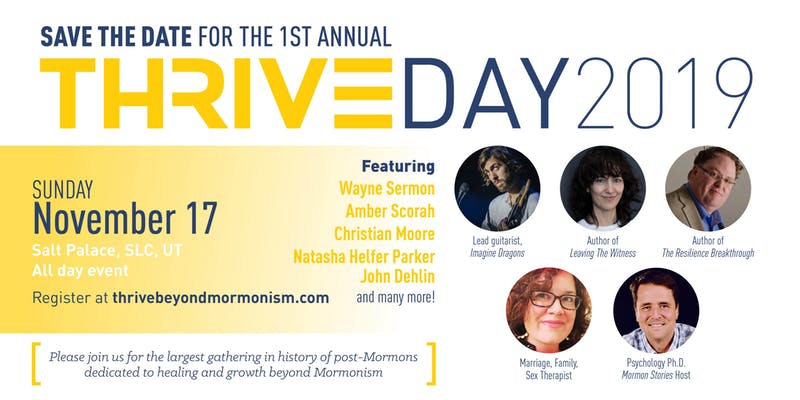
Below is an email that went out a while ago. It involves an event to take place in Salt Lake City on November 17, 2019.
Many people living in Utah are familiar with this group and its activities, but many are not. Those living outside of Utah may be less familiar with this, but in my experience, nearly every member of the Church, everywhere in the world, knows people who have left the Church for various reasons.
In very few cases does anyone leave the Church while retaining a testimony of the truthfulness of the Book of Mormon.
I include this event as part of the "Perfect Storm" series because the combination of M2C and the peep stone narrative are undercutting the basic premise for the Restoration.
That is, the Restoration is based on the premise that Joseph Smith and Oliver Cowdery told the truth about the translation of the Book of Mormon and related events. They were the sole witnesses to the translation, the restoration of the Priesthood, and the restoration of Priesthood keys in the Kirtland temple.
Modern LDS scholars who promote M2C and the peep stone narrative are teaching members of the Church to disbelieve Joseph and Oliver on key points they emphasized over and over.
This inevitably leads to an erosion of faith.
Our M2C scholars insist that Joseph and Oliver (and their successors) misled the Church about the New York Cumorah. Instead, these scholars claim the "real" Cumorah is somewhere in Mexico, with all the baggage that brings.
The revisionist historians claim that Joseph didn't really translate the plates, but instead merely read words that appeared on a peep stone he put in a hat. They are teaching this throughout the Church. Of course, that contradicts everything Joseph and Oliver ever said on the subject and questions the point of Mormon abridging the Nephite records in the first place; i.e., if Joseph didn't really translate the plates, why did everyone go to so much trouble to create and preserve them?
Joseph and Oliver specifically addressed both issues when they wrote the eight historical essays we've discussed here many times, including Letter VII. They cited facts to establish their teachings, but now these intellectuals want members of the Church to reject those facts and their teachings.
Many members of the Church reject what the M2C scholars and revisionist historians teach, but Book of Mormon Central is spending millions of dollars to promote both ideas. Now, Book of Mormon Central is promoting M2C through a scripture app designed to entice Church members away from Gospel Library.
We hope these intellectuals will reconsider their message, but based on past experience, we think that's unlikely. Instead, they will continue to promote M2C and the peep stone narrative, enforcing their beliefs by censoring and repudiating the teachings of the prophets on these topics.
As a result, we'll see more and more people confused and disturbed in their faith, exactly as Joseph Fielding Smith warned.
The upcoming event is a prime example of what happens when people lose their faith in the prophets.
We empathize with those who have lost their faith and wish them all the best. But we hope any who have lost their faith because (i) they realize that Mayans have nothing to do with the Book of Mormon, or (ii) they can't believe the peep stone narrative, will reconsider.
People would be better to repudiate the teachings of the M2C intellectuals and the revisionist historians (and their followers) than to repudiate the teachings of the prophets.
_____
We realize there are many reasons why people obtain or lose faith, but these two issues are core to faith in the restoration. That's why Joseph and Oliver addressed them in the first place and why Joseph had these essays republished so often.
It's one thing to believe what Joseph and Oliver taught about the physical reality of the Book of Mormon, citing the New York Cumorah as a fact; it's another thing altogether to reject their testimony and claim we don't know anything about where the Book of Mormon events took place.
It's one thing to believe that, as Joseph and Oliver always testified, Joseph actually translated ancient records after years of training and that he was able to accomplish a literal translation of the Title Page. It's another thing altogether to reject their testimony and claim that Joseph merely read words that appeared on a peep stone he put in a hat, a sort of supernatural teleprompter.
Some people have faith to believe in M2C and the peep stone, and that's great. But for others, it's a step too far, not only because of the inherent implausibility, but because it means that Joseph and Oliver (and their successors) misled the Church for decades.
Now that our intellectuals have undermined the credibility of Joseph and Oliver on these topics, it is more difficult for many people to believe what they taught on other topics. And once that faith is eroded...
Well, the upcoming conference is a good example of the result.
---------- Forwarded message ---------
From: John Dehlin <thrivebeyondmormonism@gmail.com>
Date: [redacted]
Subject: I need your help
To: [redacted]
Dear Friend,
On November 17th, 2019 in Salt Lake City we will be holding an event called THRIVEDAY 2019.
The purpose of THRIVEDAY is to promote healing, growth, and community for post-Mormons.
We have assembled an incredible list of speakers, which includes:
Please consider joining us for these two events. And please forward this email on to anyone who you think might want to attend. We hope to see you there.
If you're not reading Scott Adams' book Loserthink, you're missing a lot of great material.
Here are some examples:
"Being absolutely right and being spectacularly wrong feel exactly the same."
This partly explains why our M2C intellectuals don't realize that M2C is spectacularly wrong. Not only does M2C repudiate the prophets, but it is based on logical and factual fallacies that its proponents cannot recognize because they feel they are "right."
"Educated and well-informed people always have huge gaps in their knowledge of the world."
The M2C intellectuals live in a bubble like the ones on the cover of the book. They think they are somehow so "qualified" that they are justified in repudiating the teachings of the prophets.
We need a "Loserthink for Latter-day Saints" to avoid disasters such as M2C and the peep stone saga.

 The logo includes a Mayan glyph, foreclosing the possibility that the Book of Mormon could have taken place anywhere else.


 The logo includes a Mayan glyph, foreclosing the possibility that the Book of Mormon could have taken place anywhere else.