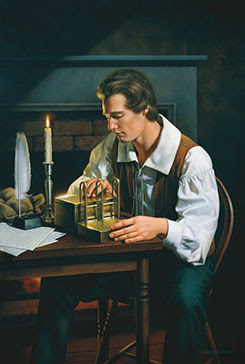
Ideas conquered long ago

Long ago, Joseph Smith and Oliver Cowdery conquered false claims that the Book of Mormon was fiction or that it came through a stone in a hat. But in recent years certain LDS scholars have resurfaced the false claims. To conquer them again, we have to return to what Joseph and Oliver taught.

Monday, June 20, 2022

The Phoenicia ship

Most readers here are probably familiar with the Phoenicia. This is the ship that was built based on an ancient Phoenician ship and sailed first from Arabia around Africa toward North America before they managed to turn it back toward Africa (Lehi's route).

On the second voyage, they sailed from the Mediterranean to Florida (Mulek's route).


The captain, Philip Beale, recently gave a presentation to the Explorers Club in Southern California at the Bowers Museum. He discusses the second voyage.

The video is on youtube here:

https://www.youtube.com/watch?v=OhNeXXKKojw


_____

Painting by Danielle Eubank (https://www.danielleeubankart.com/atlantic):


Here's a website documenting the second voyage, the Atlantic crossing.


One of the participants wrote a fairly detailed blog about her experience circumnavigating Africa on the first voyage:


Another account of the first voyage:


Here's a website on the current status of the Phoenicia:

Friday, June 17, 2022

Interview on SITH vs U&T

The single most important question in Church history involves the translation of the Book of Mormon. 

I recently did an interview about this topic on Mormon Book Reviews, which you can see here:


Here I'll summarize the question and the alternative working hypotheses. 

At the outset, I recognize that for many people, the origin of the Book of Mormon doesn't matter. 
- Some faithful LDS say the words themselves are evidence of their divine origin, regardless of how Joseph produced them. 
- Others (most critics including both unbelievers and Christian ministers) say the words themselves are evidence that their origin is not divine.

I'm fine with people believing and teaching whatever they want to. I write this blog simply to explain how I approach these questions. I don't care about persuading anyone or winning any arguments. Such a motivation would be pointless anyway, because people make up their own minds. I just encourage people to make informed decisions, based on all the available facts and after considering multiple working hypotheses.
_____

The origin of the Book of Mormon affects everything about the Book of Mormon because if Joseph Smith translated it (as he and Oliver said), then the criticisms are moot. For example, it's a foolish argument to say that a 19th century translation is not an ancient text. No one claims the Book of Mormon is an ancient text; instead, it's a translation of an ancient text. A 19th century translator would naturally use 19th century language, references, and concepts, including anachronisms, just as the KJV refers to candles and other elements that the original ancient texts don't.

Although Joseph and Oliver always described the process as a translation with the Urim and Thummim (the Nephite interpreters), there are many historical references to Joseph use of a stone-in-the-hat (SITH). For some, these are irreconcilable alternatives. Others accept one and reject (or redefine) the other. For me, the simplest, most practical and most reasonable reconciliation is the demonstration scenario that I've discussed many times, including in the interview linked above; i.e., that Joseph translated the plates by means of the Urim and Thummim, but he also used SITH to satisfy the awful curiosity of his supporters, which they inferred was a translation experience that they later expanded for apologetic reasons. IOW, bad apologetics in the 19th century has led to worse apologetics today.

The topic has many threads, with dozens if not thousands of articles, books, blogs, etc. Here I attempt to summarize and systematize the issues.
_____

The translation narrative is a combination of naturalistic and supernaturalistic elements. Supernatural, because Joseph obtained the plates from a resurrected being (Moroni) and used divinely prepared instruments to learn the characters on the plates (as he explained), and natural because Joseph used his own lexicon and worldview to articulate the literal translation of the characters (except for the Title Page, which he explained was a literal translation). 

There are two alternatives to the translation narrative: (i) a purely naturalistic explanation, that Joseph composed or copied the text he dictated, and (ii) a purely supernatural explanation, that Joseph merely dictated words that appeared on the stone-in-the-hat (the SITH theory).  

The criticisms of the divine authenticity of the Book of Mormon depend on SITH; i.e., the idea that Joseph merely read words provided by a Mysterious Incognito Supernatural Translator (MIST).  

And yet, LDS scholars such as Royal Skousen, Dan Peterson and Jack Welch agree with critics such as John Dehlin and CES Letter that Joseph Smith didn't translate the plates but instead dictated words with his face looking at a stone in the hat (SITH). They disagree only about whether Joseph (i) read words that appeared supernaturally on the stone, or (ii) dictated words he composed or memorized. 

Besides contradicting what Joseph and Oliver said, SITH creates a false set of expectations. If the MIST provided the words, they were divine and presumably should not have errors, anachronisms, etc.

The faithful SITH argument goes like this: We don't know why the MIST provided errors and anachronisms (or why the text supposedly includes artifacts from Early Modern English).

SITH has generated various apologetic responses. Skousen claims Joseph and Oliver intentionally misled everyone by referring to the Urim and Thummim. Peterson's movie on the Witnesses portrays Joseph using SITH as a fact. Welch and his Book of Mormon Central "Kno-Whys" teach SITH as a feature, not a bug. Other apologists have used variations of these.

The critical SITH argument has two branches: 

(i) The presence of errors and anachronisms proves that the words were not divine in origin; i.e., the MIST was not divine but a deception from the adversary.

(ii) The presence of errors and anachronisms proves that SITH was a ruse used by Joseph to claim a supernatural origin for a text he composed/copied.

Dehlin has done numerous episodes based on the SITH narrative, claiming that SITH is one of the major causes of the faith crises he documents. Most of the CES Letter objections to the Book of Mormon depend on SITH.  
_____

Bottom line: there is evidence to support multiple working hypotheses, but in my view the best sources are Joseph and Oliver, and all the historical evidence can be reconciled by accepting what Joseph and Oliver said; i.e., that the Book of Mormon is a translation of an ancient record. 

Wednesday, June 15, 2022

Revisionist fake history on the Church's website

This latest gem was recently brought to my attention. 

Our historians are at it again, changing Church history to accommodate M2C.

In the 1820s, the hill did not have a name. It later became known as the Hill Cumorah because Moroni, the Book of Mormon’s final author and the angel who met with Joseph Smith, wrote that he had hidden the golden plates in a hill called Cumorah (see Mormon 6:6).

https://www.churchofjesuschrist.org/learn/historic-sites/new-york/hill-cumorah?lang=eng

To make the declarative statement that "the hill did not have a name," the historians have to ignore the accounts we have, or assume they are false and thus unworthy of consideration. They also have to assume that the absence of contemporaneous records from the 1820s means that anything we don't have a contemporaneous record of didn't happen.

By this logic, the First Vision didn't happen, because that was also not reported until after the 1820s. 

Notice that the historians don't bother to state their assumptions. They certainly don't link to the actual historical accounts.

Because the Saints books have created a false historical narrative by censoring Cumorah from the record to accommodate M2C, most Church members will never know the actual Church history. 

This latest website compounds that error by inventing a fake explanation for the name Cumorah. The historians claim the hill was later named Cumorah because of Mormon 6:6, which is a flat contradiction to the historical record. But because this is what our M2C scholars want people to believe, their peers in the Church History Department have accommodated them.

_____

Regarding Cumorah, we have Lucy Mack Smith reporting two specific, distinct references to Cumorah from the 1820s. Anyone who has read the Saints book, volume 1, knows that the historians relied primarily on Lucy's account for much of the early history. Yet when it comes to Cumorah, they've concluded that her memory was wrong so they changed Church history, not for any rationale based on actual history, but instead purely to accommodate the modern opinions of the M2C scholars.

This revisionist history is literally unbelievable. It's yet another step toward fictionalizing the Book of Mormon.

_____

According to Lucy, when Moroni first appeared to Joseph Smith in 1823, he identified the hill as Cumorah:

the record is on a side hill on the Hill of Cumorah 3 miles from this place remove the Grass and moss and you will find a large flat stone pry that up and you will find the record under it laying on 4 pillars of cement— then the angel left him


Lucy also remembered Joseph referring to the hill as Cumorah in 1827 when he came home late from a trip to Manchester.

Presently he smiled, and said in a very calm tone, “I have taken the severest chastisement, that I have ever had in my life”. My husband, supposing it was from some of the neighbors, was quite angry; and observed, “I would would like to know what business any body has to find fault with you.”

“Stop, father, Stop.” said Joseph, “it was the angel of the Lord— as I passed by the hill of Cumorah, where the plates are, the angel of the Lord met me and said, that I had not been engaged enough in the work of the Lord; that the time had come for the record to <be> brought forth; and, that I must be up and doing, and set myself about the things which God had commanded me to do: but, Father, continued he, give yourself no uneasiness concerning the reprimand that I have received; for I now know the course that I am to pursue; so all will be well.”

It was also made known to him at this interview, that he should make another effort to obtain the plates on the 22d. of the following September; But this he did not mention to us at that time.


David Whitmer remembered the first time he heard about Cumorah, which was in early June 1829 when he picked up Joseph and Oliver from Harmony. Before leaving Harmony, Joseph had given the plates to a divine messenger. On the way back to Fayette, they encountered the messenger along the road.

"When I was returning to Fayette with Joseph and Oliver all of us riding in the wagon, Oliver and I on an old fashioned wooden spring seat and Joseph behind us, while traveling along in a clear open place, a very pleasant, nice-looking old man suddenly appeared by the side of our wagon who saluted us with, “good morning, it is very warm,” at the same time wiping his face or forehead with his hand. We returned the salutation, and by a sign from Joseph I invited him to ride if he was going our way. But he said very pleasantly, “No, I am going to Cumorah.’ This name was something new to me, I did not know what Cumorah meant. We all gazed at him and at each other, and as I looked round enquiringly of Joseph the old man instantly disappeared, so that I did not see him again."

REPORT OF ELDERS ORSON PRATT AND JOSEPH F. SMITH to President John Taylor and Council of the Twelve. 


Friday, June 10, 2022

video summaries of books

We recently released an updated version of Whatever Happened to the Golden Plates?

Video explanation: https://youtu.be/s0cglDYMz-w

Topic: Two sets of plates. 

Traditional view: Joseph obtained the plates from the hill in New York and returned them to the messenger when he was finished with the translation.

New view: Moroni deposited only the abridged record in the stone box in the hill. Joseph took these plates to Harmony and translated them there. He and Oliver planned to re-translate the Book of Lehi (the lost 116 pages), but the Lord told him to translate the plates of Nephi instead (D&C 10). Except Joseph didn’t have the plates of Nephi. Those plates were still in the depository of Nephite records. Before he left Harmony, Joseph gave the abridged plates to a messenger (one of the three Nephites). The messenger returned the abridged plates to the repository, picked up the plates of Nephi, and took those plates to Fayette, where Joseph translated them. 


Amazon link.

_____

We have also posted short video explanations of some of my other books. All are available wherever LDS books are sold.

A Man that Can Translate

youtube explanation https://youtu.be/4-sKO3y28qI

Topic: Joseph as an actual translator

Traditional view: Joseph translated the engravings by the gift and power of God and by means of the Urim and Thummim. Alternative view: Joseph read words that appeared on a stone in the hat (SITH), and the words were provided by a supernatural translator because Joseph didn’t even use the plates. Alternative view: Joseph was a conman who composed or copied the texts he produced.

New view: Joseph’s claim that he translated the characters (engravings) on the plates is consistent with the language he dictated and the evidence from witnesses and the Original Manuscript. Whatever the witnesses who described the stone-in-the-hat (SITH) were witnessing, it could not have been the translation because Joseph explained that he could not display the plates or Urim and Thummim that he used to translate. Evidence indicates Joseph conducted one or more demonstrations with SITH, just as he later did when people asked for revelations through the stone. Later, witnesses related SITH to refute the Spalding theory. 

Amazon link

_____

Between these Hills

youtube explanation: https://youtu.be/80DpjOEkrqI

Topic: The New York Cumorah. 

Traditional view: Moroni identified the hill as Cumorah the first night he met Joseph, and Joseph and Oliver reaffirmed that setting. Alternative view: Joseph and Oliver merely speculated about Cumorah, and/or early Church members created a false tradition about Cumorah that Joseph and Oliver adopted. Alternative view: Because the text is fiction, no Cumorah exists in the real world.

New view: Mormonism Unvailed claimed the Book of Mormon was fiction, taken from a novel by Solomon Spalding. In response, Joseph and Oliver affirmed it was a fact that the hill in New York was the same hill Mormon described in Mormon 6:6 (Letter VII). This reality has important implications for interpreting the text. Also discussed in Moroni’s America and Letter VII: Oliver and Joseph explain the Hill Cumorah.

Amazon link.

_____

Infinite Goodness

youtube explanation: https://youtu.be/_Tx0vcJeIoE

Topic: Joseph as a young religious seeker

Traditional view: Joseph was an uneducated, barely literate prophet uniquely capable of receiving revelation from God, including the text of the Book of Mormon. Alternative view: Joseph was a gifted religious genius whose “inspired eclecticism” who drew on contemporary sources to channel inspiration. Alternative view: Joseph was a charismatic conman whether pious or not.

New view: Joseph became a religious seeker when he survived life-threatening leg surgery. During his years of convalescence and after his family moved to Palmyra, he acquired “an intimate acquaintance with those of different denominations” by reading Christian literature, including the works of Jonathan Edwards. Most of the non-biblical language in the Book of Mormon and early revelations draws from Jonathan Edwards. He translated the text using his own lexicon as any translator would do, albeit inspired in his choice of words and phrasing. 

Amazon link.  

_____

Moroni's America

https://youtu.be/77RdkJ-DKPo

Topic: Setting of Book of Mormon events

Traditional view: The Book of Mormon events in the New World covered the entire Western Hemisphere, with Panama as the narrow neck separating the "land northward" from the "land southward" and the hill Cumorah in western New York. Alternative view: The events took place within a limited area of Mesoamerica with the hill Cumorah in southern Mexico, meaning that Joseph and Oliver misled everyone about the New York Cumorah.

New view: Joseph and Oliver were correct about the New York Cumorah and the text of the Book of Mormon describes a North American setting that is consistent with extrinsic evidence from archaeology, anthropology, geology and geography. Understanding this setting helps readers better understand the teachings of the prophets about the text and its relevance today.

Amazon link.


Thursday, June 9, 2022

Simplicity revised

One of the most popular posts on this blog was titled "Simplicity." I originally posted it on May 26, 2016. I'm reposting it here, with some additional material.

Simplicity

William of  Ockham
The simplest explanation is usually the best, a principle often described as Occam's razor. "Among competing hypotheses, the one with the fewest assumptions should be selected."

On the topic of Book of Mormon geography, which setting requires the fewest assumptions?

Which explanation is the simplest?
_____

The New York  Cumorah has one assumption.

1. Joseph Smith and Oliver Cowdery knew that the Hill Cumorah in New York was the place where the Nephite and Jaredite civilizations were destroyed and the location of the repository of Nephite records (Mormon 6:6). 

The historical record shows us that Moroni told Joseph the name of the hill the first time they met. Joseph and Oliver visited the repository of Nephite records in the hill (which was separate from Moroni's stone box). 

Everything directly attributable to Joseph and Oliver is consistent with that setting. The text of the Book of Mormon, as well as extrinsic scientific evidence, corroborates that setting.

Contrary ideas that Cumorah is not in New York are not directly attributable to them; therefore, these contrary ideas were produced by other people who didn't know (or didn't believe) what Joseph and Oliver knew and taught.
_____

Modern LDS scholars such as Jack Welch and Dan Peterson and their followers reject the New York Cumorah because it conflicts with their personal theories that the setting of the Book of Mormon events is in Mesoamerica. While they recognize the historical references to Cumorah, they rationalize that there are "two Cumorahs" with a false one in New York and the real one in southern Mexico.

The Mesoamerican/Two Cumorahs theory (M2C) relies on a series of assumptions:

1. Joseph Smith didn't know where the Book of Mormon events took place.

2. Joseph misled his mother Lucy Mack Smith when he told her what Moroni told him about Cumorah and when he referred to the hill as Cumorah before he even got the plates; or else Lucy misremembered or misled her readers when she dictated her history.

3. Oliver Cowdery (or another unknown person) at some unspecified date started a false folk tradition that Cumorah was in New York, based on an incorrect assumption. 

4. David Whitmer reported meeting the messenger who was taking the abridged plates from Harmony to Cumorah, but either the messenger lied, or David lied about that meeting or conflated his own specific memory of the first time he heard the word "Cumorah" with Oliver's folk tradition.

5. Joseph misled his wife Emma when he wrote to her about crossing the plains of the Nephites after he'd crossed Ohio, Indiana, and Illinois.

6. As Assistant President of the Church, Oliver misled everyone when he memorialized the false folk tradition in Letter VII in July 1835, published in the Messenger and Advocate. 

7. Joseph, for unexplained reasons, passively adopted Oliver's false speculation, had it copied into his personal journal as part of his life history, and specifically encouraged its re-publication in the Gospel Reflector and Times and Seasons, while his brother William republished it in The Prophet.

8. Oliver lied to Brigham Young, Heber C. Kimball, David Whitmer, etc. when he told them about visiting the repository of Nephite records in the hill Cumorah in New York; or else these witnesses lied about what Oliver told them.

9. Joseph, who wrote very little himself, nevertheless wrote a series of lengthy articles in the Times and Seasons about Central America in 1842 that he left anonymous for unknown reasons. Although the articles didn't mention Cumorah, RLDS scholar L.E. Hills determined that Cumorah cannot be in New York because of these articles. He published the first M2C map in 1917

10. In September, 1842, Joseph misled everyone when he specifically referred to Cumorah in a signed letter published in the Times and Seasons (now D&C 128:20), because he referred to the hill in New York from which the "glad tidings" came as Cumorah.

11. Brigham Young, Heber C. Kimball, Wilford Woodruff, and others of Joseph's contemporaries and successors misled everyone because they believed what Joseph and Oliver about the hill Cumorah. 

12. Certain LDS scholars such as John Sorenson, Dan Peterson, Jack Welch, and their followers have corrected the false tradition perpetrated by Joseph and Oliver because they, the scholars, know more about Cumorah than Joseph and Oliver did. These modern M2C scholars have determined that L.E. Hills' map is correct after all, albeit with minor corrections.

13. Anyone who still believes what Joseph, Oliver and their associates taught about the New York Cumorah is either ignorant, an apostate or is verging on apostasy.

14. Etc.

Which set of assumptions makes the most sense to you?

____________________________

Here are some relevant quotations about simplicity.

“If you can't explain it to a six year old, you don't understand it yourself.”
― Albert Einstein

To which Groucho Marx replied:

“A child of five could understand this. Send someone to fetch a child of five.”
― Groucho Marx

“Truth is ever to be found in the simplicity, and not in the multiplicity and confusion of things.”
― Isaac Newton

“Why did they believe? Because they saw miracles. Things one man took as chance, a man of faith took as a sign. A loved one recovering from disease, a fortunate business deal, a chance meeting with a long lost friend. It wasn't the grand doctrines or the sweeping ideals that seemed to make believers out of men. It was the simple magic in the world around them.”
― Brandon Sanderson, The Hero of Ages

“People who pride themselves on their "complexity" and deride others for being "simplistic" should realize that the truth is often not very complicated. What gets complex is evading the truth.”
― Thomas Sowell, Barbarians inside the Gates and Other Controversial Essays

“..things are never as complicated as they seem. It is only our arrogance that prompts us to find unnecessarily complicated answers to simple problems.”
― Muhammad Yunus, Banker to the Poor: Micro-Lending and the Battle Against World Poverty

“I am not a genius, I am just curious. I ask many questions. and when the answer is simple, then God is answering.”
― Albert Einstein

Tuesday, June 7, 2022

MHA 2022 report - SITH alive and well

MHA (the Mormon History Association) attracts a variety of wonderful people who share a common interest in Mormon history (Mormon meaning everyone interested in all things Mormon, including but not limited to LDS topics). There were around 200 presenters, many in person and many remote on Zoom. 

The panels discussed a wide range of topics from many different points of view. 

With respect to SITH (the stone-in-the-hat theory), however, there isn't much room for alternative perspectives and interpretations. 

MHA "seer stone"
As an demonstration of how entrenched SITH is among Mormon historians, there is an annual tradition at MHA: the transfer of the “Mormon History Association Presidential Seer Stone” from the past president of MHA to the incoming president. 

One historian described the stone this way: "This stone is a chunk of rock from historian Leonard Arrington’s boyhood farm in Idaho, plucked out of the irrigation ditch by the late and much missed Dean L. May near the close of Dean’s tenure as MHA president. Each MHA president since then has had custody of the stone during his or her tenure, a constant, solid reminder of the goals and principles of MHA."

This tradition started 20 years ago. 

It's not clear how this "seer stone" represents the "goals and principles of MHA," but one of the goals is apparently to keep SITH alive and well. 

One session challenged the modern "consensus" that Joseph Smith produced the Book of Mormon with the seer stone he found in a well. One of our favorite smooth-faced SITH scholars posed a typically ridiculous rhetorical question. Others in the audience had some meaningful comments and questions. Afterward, a woman in the audience said she was glad to hear an alternative to SITH because the seer stone narrative didn't make any sense.

The SITH narrative today is based on poor apologetics from the 19th century, relies on out-of-context statements, and embraces the pejorative rhetoric from the 1834 book Mormonism Unvailed. Yet scholars have come up with a variety of rationalizations to paper over the obvious problems with SITH. 

I'll discuss the conference more when I have time. 

Key reminder: You can dislike someone's opinion without disliking the person who has it.


Thursday, June 2, 2022

MHA 2022 Logan, Ut

MHA is the Mormon History Association. 

https://mormonhistoryassociation.org/

This year we have a focus on the arts, which is exciting. 

I'm speaking Friday morning on a panel with two other wonderful historians. I'll discuss it more next week.