Ideas conquered long ago

Long ago, Joseph Smith and Oliver Cowdery conquered false claims that the Book of Mormon was fiction or that it came through a stone in a hat. But in recent years certain LDS scholars have resurfaced the false claims. To conquer them again, we have to return to what Joseph and Oliver taught.

Friday, May 6, 2022

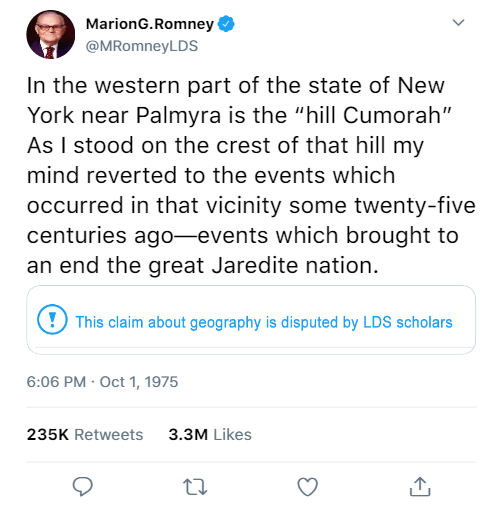
Reaffirming the New York Cumorah

A few random thoughts related to the reason this blog continues to reaffirm the teachings of the prophets about the New York Cumorah, despite the opposition from the M2C citation cartel.

First, I posted a preliminary version of an article I'm going to post soon on academia.org. It's another example of how our modern LDS historians distort Church history to accommodate M2C.

Here's the link:

http://www.ldshistoricalnarratives.com/2022/05/real-vs-rumor-part-3-historians-knowing.html

_____

Here are some relevant thoughts from Twitter.

Don't worry about who will be offended if you speak the truth. Think about who will be misled and deceived if you don't.


One of the most pathetic—and dangerous—signs of our times is the growing number of individuals and groups who believe that no one can possibly disagree with them for any honest reason.

Spend less time convincing people who can't see your vision, and more time building the future with those who do.

_____

Related to this, there's a new post about the book Real vs. Rumor here:


Thursday, May 5, 2022

Abortion and M2C

The recent leak of a draft Supreme Court opinion has made abortion a major topic in the news lately.*

When I was walking on the beach yesterday, I listened to a podcast that clarified the difference between the pro-life and pro-choice arguments. The analysis paralleled the difference between the M2C and NY1C arguments.

As always, I emphasize that I don't care what anyone thinks. I'm interested in the psychology behind belief and the types of arguments people make. Whether you are pro-life or pro-choice, M2C or NY1C, I encourage you to look at this comparison analytically and objectively.

_____

The key distinction between the abortion arguments is this: One side can say exactly what they think and what they want. The other has to use the fog of argument, in this case the "laundry list" persuasion tactic, because it's a little embarrassing to say in public what their position is.

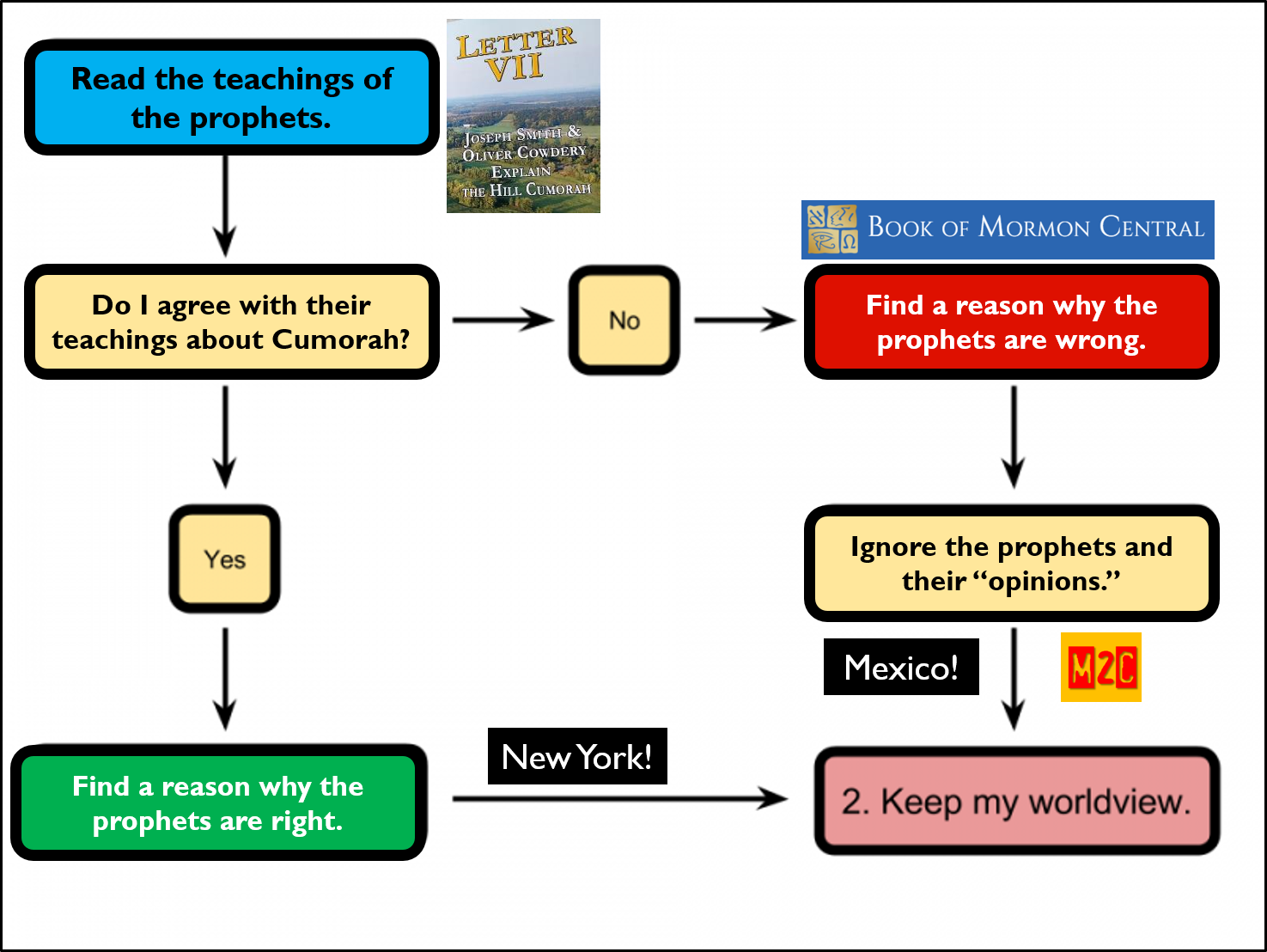
We have a similar situation with the Cumorah issue. One side can say exactly what they think; i.e., that the prophets were correct about the New York Cumorah. The other has to use the fog of argument (such as the laundry list) because it's a little embarrassing in LDS circles to openly declare that the prophets were wrong about the New York Cumorah.

Here's a summary table:


Proud to declare publicly

Better to obscure with “laundry list”

Abortion arguments

I believe/think that life begins at conception and that life is sacred and shouldn’t be terminated for convenience.

I value my own life, freedom and choices over that of a potential life, something that could be or not be a life; i.e., a “maybe baby.”

Cumorah

The prophets were correct when they taught that the Hill Cumorah of Mormon 6:6 is in western New York.

The prophets were wrong when they taught that the Hill Cumorah of Mormon 6:6 is in western New York.

_____

People opposed to abortion (pro-life) can state their reasons clearly and in public. The pro-life argument goes like this: my religious belief or intuition says that life begins at conception, that life is sacred, and that life shouldn't be ended for any reason. 

It's a clean argument that people are proud to say in public, openly and without lots of rationales, explanations, etc. 

By contrast, those who favor abortion access (pro-choice) tend to skirt their real argument, which is: They value their own quality of life, including financial  and personal freedom and choices, over that of a merely potential life. But that sounds selfish.

Instead, they obscure the argument with rhetoric based on choice and freedom, using "laundry list" persuasion to avoid clarity. They hope that if they give 10 reasons, people are going to think, "You know, I don't know that much about this issue, but if there are 10 reasons... Ten reasons are way more than one. Way more than three. Even if I don't understand the reasons, I don't need to get into the details when there are 10 reasons."

Making an argument based on quantity is persuasive by itself; it doesn't matter whether any of the reasons have merit.

The laundry-list tactic is designed for weak arguments. But the pro-abortion people do not have a weak argument. They have a strong argument that has one weird quality: They don't want to say it in public.

Their argument is strong from a persuasion perspective. If they said their actual argument, favoring their personal freedom over what they consider potential life, we could say, "Oh, that's a pretty strong argument, even if I don't agree with it."

They also invoke particularly tragic and rare cases that generate understandable sympathy, then transpose those exceptional situations onto the far more common cases of personal convenience.

_____

The abortion debate is essentially a disagreement about assumptions.

To the Left, their starting assumption is this fetus might be a baby, and might not. It's a "maybe baby." They frame the debate as being over the value of the "maybe baby." If you think a fetus is something that could be, or might not be, a life, then you go the direction of why should I let my life be determined by something that's a maybe. 

On the other side, people think that conception produces life that is sacred.

Many people seek to balance the two interests by recognizing exceptions in exceptional situations.

_____

Similarly, the debate about Cumorah is a debate about assumptions. 

Those who accept the New York Cumorah (NY1C) assume the prophets told the truth

Those who reject the New York Cumorah in favor of M2C (the Mesoamerican/two-Cumorahs theory) assume the prophets were wrong.

Thus, those who still believe what the prophets have taught about Cumorah (NY1C) can state their reasons clearly and in public. 


It's simple and clear: we know the Cumorah of Mormon 6:6 is in western New York because (i) Moroni told Joseph Smith about it the first time they met, (ii) Joseph, Oliver (Letter VII) and their successors reaffirmed that basic point, and (iii) the extrinsic evidence corroborates those teachings. 

By contrast, those who advocate M2C (or any other non-New York Cumorah) use the fog of argument, including laundry lists, to soften their repudiation of the teachings of the prophets. There are dozens of examples at FAIRLDS, Book of Mormon Central, the Interpreter, Meridian Magazine, the old FARMS database, etc.

For an LDS audience, outright rejection of the teachings of the prophets is generally unpersuasive. Knowing this, M2C proponents are clever enough to provide a laundry list of reasons, as we've seen many times on this blog. Some of them have even created numbered lists of reasons why Cumorah cannot be in New York, including the absence of volcanoes and the presence of snow. 

M2C promoters make convoluted, irrational arguments such as their claim that (i) because Joseph Smith was the nominal editor of the Times and Seasons in 1842, (ii) he must have approved of anonymous editorials that claimed ruins in Mesoamerica were left by the Nephites, (iii) which means that he must have implicitly (yet silently) rejected the New York Cumorah (iv) because New York is "too far" from Mesoamerica.

They usually ignore the historical and extrinsic evidence that supports the New York Cumorah, including the fact that Joseph's own brothers republished Letter VII both before and after those 1842 editorials. 

When they do address the NY1C evidence, they attribute it to a false tradition created by early Latter-day Saints who merely speculated about Cumorah. They say Joseph Smith passively adopted the false tradition. They say Lucy Mack Smith's memory was poor, or she was confused, or she incorporated false traditions. They say David Whitmer and Martin Harris and Oliver Cowdery adopted the false tradition, and that Oliver Cowdery misreported what Moroni told Joseph Smith. They say Oliver misled people when, as Assistant President of the Church, he declared unambiguously that it was a fact that the Cumorah of Mormon 6:6 is in New York.  They say all of Joseph's contemporaries and successors who have ever addressed the topic were wrong.

Why?

Because they, the scholars, know better.

Hence, the M2C advocates resort to laundry-list arguments and other sophistry to persuade the Latter-day Saints to unknowingly reject the teachings of the prophets about Cumorah! 

_____

*Pro-choice activists claim the Supreme Court decision would deprive people of abortion rights, but that's a misleading tactic of thinking past the sale because the issue is really about who decides: the U.S. Supreme Court or the states. Reasonable people can disagree about that.

Abortion advocates know that people are more likely to respond emotionally to losing something than to potentially gaining something. Loss aversion is more persuasive, so framing it as "losing a right" is effective persuasion, but it's an analytical red herring.

And, of course, the leaked opinion was a draft that might not even be the final opinion of the Court, which means this could end up be a controversy about a hypothetical.


Friday, April 29, 2022

M2C NPCs

Elon Musk's acquisition of Twitter has brought out the differences of opinion about "free speech." Here's an summary from a Twitter user:

Perhaps what is happening here is that the left doesn’t want to engage in any debate because they know that they can’t win the argument if the other side is allowed to speak.

The parallels to the M2C and SITH citation cartels are apparent. 

Consequently, I keep hearing the same tired, ridiculous arguments from M2Cers:

_____

Q. The Book of Mormon doesn't mention snow (except as a metaphor), so how could it have taken place in the Midwestern states through New York where it snows annually?

A. The New Testament doesn't mention snow (except as a metaphor), so how could it have taken place in Israel, Turkey, etc., where it snows annually?

Neither the Book of Mormon nor the New Testament related weather reports.

_____

Q. There are no volcanoes in New York or the Midwestern states, so how could Book of Mormon events have taken place there?

A. There are no volcanoes in the Book of Mormon, so why is anyone looking for volcanoes in Book of Mormon lands?

_____


Thursday, April 28, 2022

Friday, April 22, 2022

Why the cartels resist multiple working hypotheses

The concepts of "free speech" and access to information is in the news a lot lately, for good reason. People cannot make informed decisions without good information. President Nelson has taught that "good inspiration is based upon good information."

Yet the twin citation cartels deprive people of good information.

The M2C/SITH citation cartel, led by Jack Welch, Dan Peterson, and Scott Gordon, continues to demand allegiance to their particular interpretations of Church history and Book of Mormon historicity. They and their followers not only don't want people to know about alternative faithful interpretations, but they treat fellow Latter-day Saints as apostates if they don't swear allegiance to M2C and SITH. 

The critical citation cartel, led by John Dehlin and Jeremy Runnels, also continues to demand allegiance to their particular interpretation of Church history and Book of Mormon historicity. They and their followers also don't want people to know about alternative faithful interpretations. 

In both cases, the cartels cannot tolerate alternative interpretations, even (especially) when those alternatives both (i) explain the evidence and (ii) corroborate the teachings of the prophets.

Both cartels resort to censorship and logical fallacies to maintain their control over their respective followers. On this blog we've looked at many examples over the years.

Everyone interested in these issues, whether faithful Latter-day Saint, former Latter-day Saint, or never Latter-day Saint, deserves to know about (i) all the relevant facts and (ii) multiple working hypotheses based on those facts.

You'd never know it by reading or listening to either of the cartels, but people can be faithful Latter-day Saints regardless of what they believe about Book of Mormon historicity/geography and the translation of the Book of Mormon.

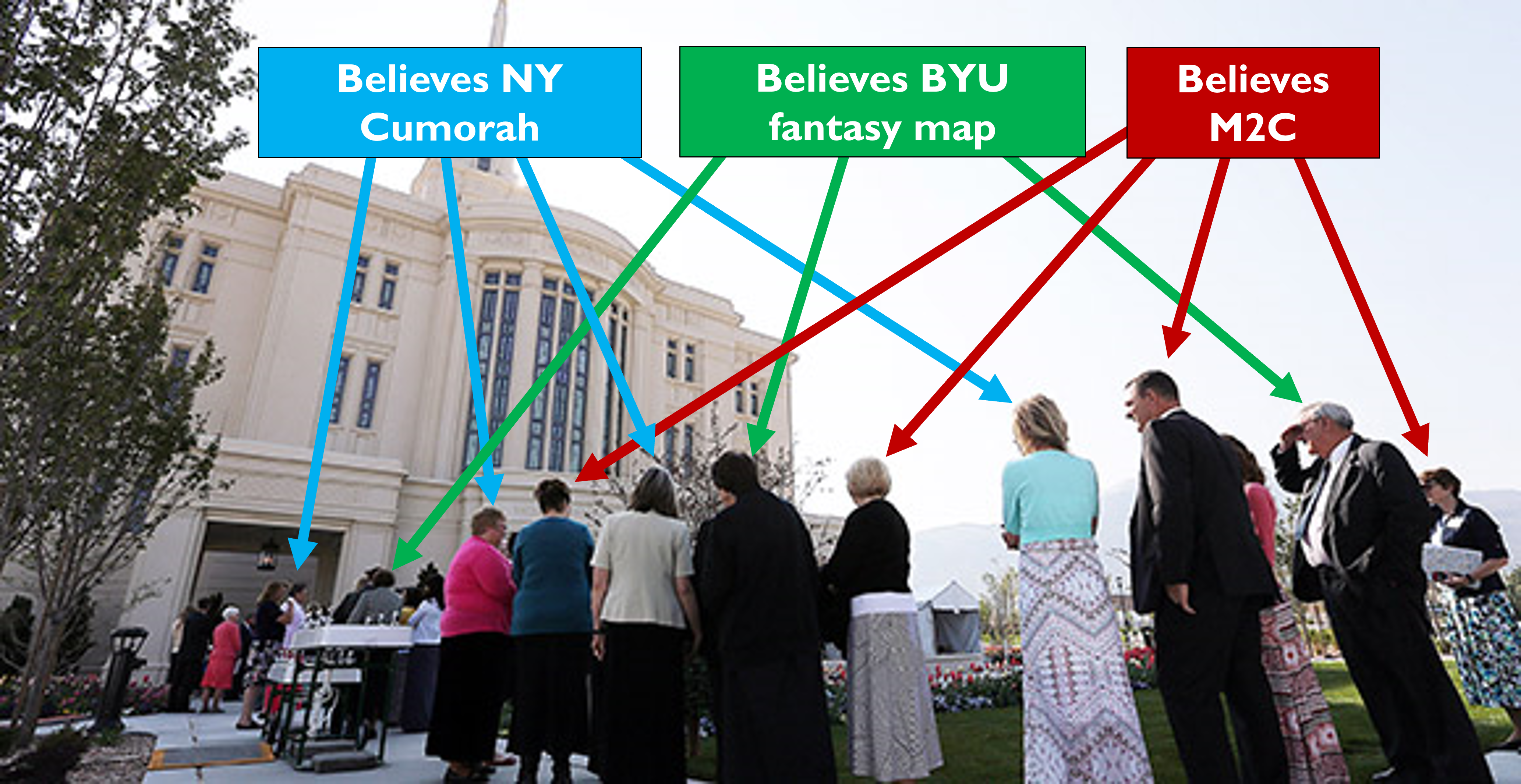
This graphic, which I use frequently, demonstrates the concept.


On this blog, we encourage readers to consider all the relevant facts and multiple interpretations of those facts (multiple working hypotheses). We freely cite and refer to the twin citation cartels because we think the best way for people to make enduring decisions is to make informed decisions.

Yet Jack Welch, Dan Peterson, and Scott Gordon, along with John Dehlin and Jeremy Runnels, all insist on intellectual conformity and compliance. We think it's an enormous mistake for Book of Mormon Central, in particular, to demand allegiance to the personal opinions of Jack Welch, to the exclusion of alternative faithful interpretations.  

The worst offender is undoubtedly Book of Mormon Central. They directly violate their own purported mandate by insisting on M2C and SITH. They've raised and spent over $8 million from faithful Latter-day Saints by claiming "neutrality" on these issues while censoring alternative faithful views and by teaching only one permissible interpretation of the Book of Mormon historicity/geography.

If I was a donor to Book of Mormon Central, I'd be furious that my donations were misused and squandered this way. 

Actually, had I donated to any of these cartel members, I'd be furious.

_____

The Church is, or should be, a big tent that accommodates a variety of interpretations, interests, and areas of emphasis. 

Paul and Moroni explained this a long time ago:

4 Now there are diversities of gifts, but the same Spirit.

 5 And there are differences of administrations, but the same Lord.

 6 And there are diversities of operations, but it is the same God which worketh all in all.

7 But the manifestation of the Spirit is given to every man to profit withal.

8 For to one is given by the Spirit the word of wisdom; to another the word of knowledge by the same Spirit;

9 To another faith by the same Spirit; to another the gifts of healing by the same Spirit;

10 To another the working of miracles; to another prophecy; to another discerning of spirits; to another divers kinds of tongues; to another the interpretation of tongues:

 11 But all these worketh that one and the selfsame Spirit, dividing to every man severally as he will.

 12 For as the body is one, and hath many members, and all the members of that one body, being many, are one body: so also is Christ.

13 For by one Spirit are we all baptized into one body, whether we be Jews or Gentiles, whether we be bond or free; and have been all made to drink into one Spirit.

 14 For the body is not one member, but many.

 15 If the foot shall say, Because I am not the hand, I am not of the body; is it therefore not of the body?

 16 And if the ear shall say, Because I am not the eye, I am not of the body; is it therefore not of the body?

 17 If the whole body were an eye, where were the hearing? If the whole were hearing, where were the smelling?

 18 But now hath God set the members every one of them in the body, as it hath pleased him.

 19 And if they were all one member, where were the body?

 20 But now are they many members, yet but one body.

21 And the eye cannot say unto the hand, I have no need of thee: nor again the head to the feet, I have no need of you.

22 Nay, much more those members of the body, which seem to be more feeble, are necessary:

 23 And those members of the body, which we think to be less honourable, upon these we bestow more abundant honour; and our uncomely parts have more abundant comeliness.

 24 For our comely parts have no need: but God hath tempered the body together, having given more abundant honour to that part which lacked:

25 That there should be no schism in the body; but that the members should have the same care one for another.

26 And whether one member suffer, all the members suffer with it; or one member be honoured, all the members rejoice with it.

27 Now ye are the body of Christ, and members in particular.

(1 Corinthians 12:4–27)


Thursday, April 21, 2022

Why write about Cumorah?

I write about the New York Cumorah on this blog to remind independent-minded people (engaged learners) who often feel outnumbered that they're not alone. 

Independent-minded people seek truth. They want information to make informed decisions. They know, as President Nelson has taught, that good inspiration comes from good information.

They seek to corroborate, not repudiate, the teachings of the prophets. The Cumorah issue is fundamental to understanding not only Church history, but the context and implications of the Book of Mormon.

_____

By contrast, neither the M2C citation cartel nor the critical citation cartel considers evidence that contradicts their parallel belief systems, both based on the premise that the prophets were wrong.

We all know there is no chance that our M2C and SITH scholars will change--or even open==their minds, no matter what information is available. The citation cartel (Book of Mormon Central, the Interpreter, FAIRLDS, Meridian Magazine, etc.) is too deeply invested to consider the possibility that the prophets were correct after all. After decades of trying to persuade the Latter-day Saints that the prophets were wrong about Cumorah and the translation of the Book of Mormon, they can hardly change course now.

They are the mirror image of the critical citation cartel (MormonStories, CES Letter, etc.) who are equally invested in their narrative that the prophets were wrong.


Thursday, April 14, 2022

False dilemmas: year 1900 Book of Mormon geography debates

The logical fallacies behind M2C (the Mesoamerican/two Cumorahs theory) are nothing new. Book of Mormon scholars have been resorting to logical fallacies for over 100 years. 


The January 1900 issue of Autumn Leaves reported on a debate about Limhi's explorers that involved this question: "Did Ether take the plates to the land Desolation, or did Limhi's party go to New York State?"


The assumption behind the question is that the final battles of the Jaredites took place in New York, but that the "land of Desolation" was in Mexico. 

This is the logical fallacy of false dilemma or false dichotomy that our M2C friends engage in. In this case, the false dilemma is that they don't consider a third option; i.e., that the land of Desolation was not far from New York.

These early debates eventually compared only two alternatives: a hemispheric model vs a limited model in Mesoamerica. When only those two alternatives are considered, the limited model makes more sense. 

But the limited model only works if Cumorah is in Mexico, despite what Joseph, Oliver, and their contemporaries and successors taught about Cumorah in New York. Hence the development, by a process of reasoning, of M2C.

The debates in the early 1900s never considered the possibility of a limited geography based on the New York Cumorah.

Our current M2C citation cartel likewise rejects the possibility of a limited geography based on the New York Cumorah.

That's why so much confusion exists, even though Joseph and Oliver explained the facts in words as plain as words can be.

Those interested should read an awesome blog that is documenting the origins of M2C.

https://twocumorahsolution.blogspot.com/2021/03/autumn-leaves-autumn-leaves-was-first.html?m=1

_____


Definition: A false dilemma, also referred to as false dichotomy, is an informal fallacy based on a premise that erroneously limits what options are available. The source of the fallacy lies not in an invalid form of inference but in a false premise.