long ago ideas

“When we are tired, we are attacked by ideas we conquered long ago." - Friedrich Nietzsche. Long ago, Joseph Smith and Oliver Cowdery conquered false claims that the Book of Mormon was fiction or that it came through a stone in a hat. But these old claims have resurfaced in recent years. To conquer them again, we have to return to what Joseph and Oliver taught.

Sunday, December 7, 2014

Directions in the Book of Mormon

Mayan directions

What do the Book of Mormon authors mean when they use directions (North, South, East, West) in the text?

If they mean the cardinal directions as we know them today, the Mesoamerican theory is basically impossible. Consequently, John Sorenson theorized that the BoM authors based their cardinal directions on the coastline. In Israel, the Mediterranean coast runs north/south, with the sea on the west and the land on the east, so any sense of direction based on the coast agrees with what we moderns know as the cardinal directions. In other cultures, a reference to a coastline would not line up with the directions on a compass.

Or, as Deane Matheny explained it (as quoted by Brant Gardner):

The most fundamental geographical problem associated with Sorenson’s model has to do with issues of directionality. . . . In order for his model to fit the geography of Mesoamerica, one must assume that the Nephites had a system of directions with cardinal directions skewed “45 degrees or more” off of the usually observed cardinals. . . . In other words, the whole directional card must be shifted more than 60 degrees to the west for this model to fit the geography of the chosen area. Otherwise, as Vogel has pointed out, the land north will be on the west, and the south on the east, and so forth. . . . Making this shift in directions creates its own set of problems, however, because in such a Nephite directional system the sun would come up in the south and set in the north.3

Vogel is far from the only critic to point out this fundamental problem; it's a favorite of anti-Mormon critics generally, as well as a target for faithful LDS who reject the Mesoamerican theory.

Another theory advanced by Brant Gardner takes a more cultural/linguistic approach. Here's how he summarizes it:

I propose that if Mesoamerica is a good fit for the Book of Mormon’s real world geography, then information about Mesoamerica may be used to reexamine and refine the nature of that fit.5 In short, an understanding of the Mesoamerican directional system offers an explanation for the way that Book of Mormon directions correspond to that geography, without recourse to an artificial shift in the directions.

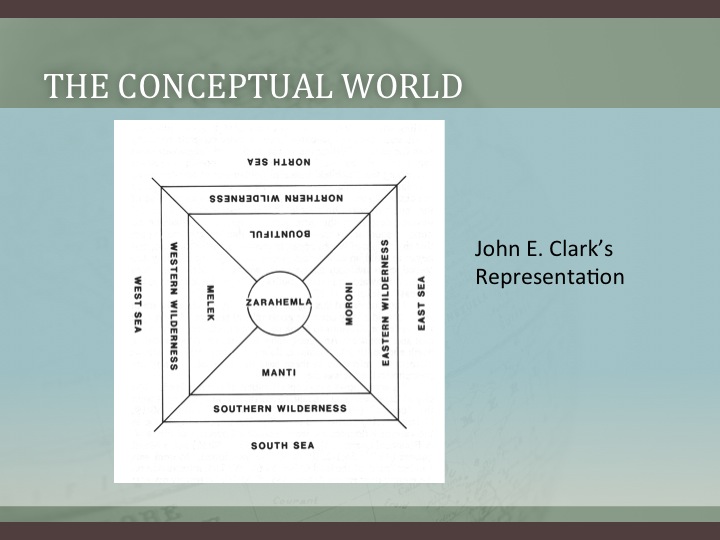
Gardner offers a detailed and well-reasoned explanation of the Mayan system which leaves the issue of directions far more fluid than one would expect by simply reading the text. Basically, he suggests the Mayans viewed directions as quadrants:

There was no “north” in the Mesoamerican system–only a spatial relationship to that side of the sun’s path. That is why the vocabulary varies so greatly. It wasn’t that Mesoamericans didn’t know where north was, they conceived it entirely differently. It existed only as a quadrant on the right or left of the sun’s path—where some Mesoamerican cultures called it “right” and some “left.”

He notes this about the Hebrew concept:

William J. Hamblin, professor of History at Brigham Young University notes: The Hebrews, like most Semitic peoples, oriented themselves by facing east, toward the rising sun. Thus east in Hebrew was simply front (qedem), with south as right (yamîn), north as left (śemôl), and west as rear (achôr) or “sea” (yam). . . .
My take on Gardner's thesis boils down to this: he's trying to reconcile the fact that the plain text of the Book of Mormon contradicts the Mesoamerican theory. This leads him to superimpose the Mayan concept of directions onto Joseph Smith's translation, so that, as Matheny explained, the term "north" in the Book of Mormon doesn't mean "north" but another vague direction, anywhere in the quadrant (the breadth of which varies depending on the time of year) that is before your face if your left arm is pointed at the setting sun.

This leads him to this conclusion:

Combined with the differences in terminology and cultural perceptions, it is little wonder that the Book of Mormon directions appear difficult fit onto a modern map. That inherent difficulty becomes even greater when we insist upon reading literal geographic statements where the text does not intend a literal reading. That is the issue that clouds our understanding of the Nephite seas.

He proceeds to discuss how the concept of seas in cardinal directions could be metaphorical, and how the references to a "sea east" could have meant two different seas, based on the frame of reference (Land of Nephi vs. Bountiful).

This opens possibilities very wide indeed.

I'm led to wonder whether this approach undermines any effort to "map" the Book of Mormon, whether in Mesoamerica or North America. We don't know, specifically, how the Hopewell civilization perceived directions. Maybe they adopted an approach similar to the Mayans. Would the Nephites have retained the Hebrew understanding of directions? Would Mormon, having seen our day, use a system of cardinal directions that we wouldn't understand (until Brant Gardner figured it out)?

I think Gardner has gone a long way toward addressing the problem of directions in the Mesoamerican theory, but in so doing, he has introduced another layer of uncertainty into the text. Is this akin to the "modern expansion of an ancient text" approach that undermines the reliability (and credibility) of the Book of Mormon? He sees it as additional evidence for the Mesoamerican theory. (Of course, if he reached a different conclusion, he wouldn't have published his paper.)

But another way to look at it is that he has opened up new possibilities for understanding the North American theory as well.

Here is Gardner's conclusion:

Conclusion

The most serious contraindication for Sorenson’s correlation between Mesoamerica and the Book of Mormon has been his shifting of north some 60 degrees to the west. The quality of the correlations with the rest of the geography and cultural data suggest that we look to Mesoamerica to see if the cultural data from the region in which the Book of Mormon took place (according to this correlation) might provide an understanding of what has come to be called “Nephite North” (though it is not a term Sorenson used55). The combination of the Mesoamerican center and the perception of the quadrants as wedges emanating for that center explain how the Book of Mormon “north” might include a region that our cultural predisposition for cardinal directions would not recognize. Combined with the shifting center points from which directions or spatial relationships may be discussed, we have a culturally appropriate understanding the underlying plate text directions that yielded the English translations of north, south, east and west. In addition to explaining the spatial terms, it also provides a cultural underpinning for why the land northward was Desolation and the land southward Bountiful. Sorenson’s geographic correlation not only remains the best supported, but what has been a directional conundrum actually provides further indication that the plate text was written in a region steeped in the Mesoamerican understanding of spatial orientation.

"Reconciling" a square peg into a round hole

I've been following this issue of Book of Mormon historicity and geography for many years (decades, actually), which is long enough to know that the Mesoamerican apologists think all the questions have been asked and answered. They seem impervious to criticism at this point, and assume everyone else interested in the issue is either in their camp, not LDS, or is a crazy fanatical "Heartlander." They repeatedly denigrate proponents of the North American theory and even to consider the abundant archaeological evidence in New York, Ohio, Illinois, Missouri, and Iowa. They are unwilling to objectively evaluate the evidence from church history, feeling compelled to "reconcile" it with the Mesoamerican theory. But as the discussion below shows, the entire Mesoamerican theory is based on three excerpts from the Times and Seasons (not counting John Page's comments after he was excommunicated). But the T&S itself published more detailed and extensive links between specific Book of Mormon history and the archaeology of Ohio. All of Joseph Smith's personal writings, his statements recorded by others, and specific verses in the D&C are consistent with the T&S Ohio comparisons. Yet Mesoamerican theorists are compelled to discredit each of these to "reconcile" them with the Mesoamerican theory. A recent example of this was published in the Interpreter. Mark Alan Wright titled his piece:

Heartland as Hinterland: The Mesoamerican Core and North American Periphery of Book of Mormon Geography


There was a fascinating discussion over on Pathos, which I'll cover here. Dan Peterson asked about how many youth leave the Church and what can be done about it. He cited a study that, ironically, showed that LDS youth remain faithful and active through college at far higher rates than any other denomination surveyed, including Catholics, Jews and Conservative, Black, and Mainline Protestants. This seemed to have comforted most of the responders; i.e., the Church is doing pretty well, by comparison.

Contrary to the "status quo consensus," the point was raised in one comment that the Mesoamerican theory is causing many people to leave the Church, as well as deterring investigators from joining.

Most participants claimed there is no problem with the Mesoamerican theory having this impact, or that they are unaware of any such problem. That response astonishes me. Aside from my personal experience with family and friends, which admittedly is anecdotal, the blogs are replete with ridicule of the Mesoamerican theory, both from scientists and lay persons. But worse, the theory itself requires one to believe the BoM was not accurately translated, that Joseph Smith didn't know much about the Nephites, that his contemporaries (including his mother) inaccurately reported what happened, etc.

The original post:

“How many youth are we losing?”


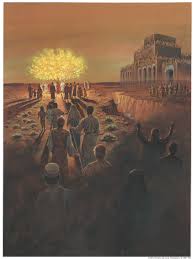
An image of Lehi's dream
1 Nephi 8
Still very relevant
 I often see claims from critics — mostly from former members — that The Church of Jesus Christ of Latter-day Saints is dying, and that, in particular, it’s hemorrhaging young people.
 And perhaps we are.  Certainly, we’re losing more than I could wish.
 I think often about what I, personally, might be able to do in order to help stanch the flow.
 But we always did, I think.  Even back in the middle Jurassic, when I was young, we lost far too many young people.
 However, I don’t see a lot of statistics.
 And some critics, immersed as they are in apostate message boards and the like, may simply be confusing their little corner of the universe with the whole of it.  They may be extrapolating from a rather small and quite unrepresentative sample.
 But maybe not.
 Here’s a brief attempt to analyze some relevant numbers:
Read more: http://www.patheos.com/blogs/danpeterson/2014/12/how-many-youth-are-we-losing.html#ixzz3LHOs0vnw


Then Dan posted this:

I'm unaware of anything to suggest that youth are leaving the Church in response to proposed Mesoamerican geographical models for the Book of Mormon.
In any event, I hold to a Mesoamerican model because I think it's the best one available. Unfortunately I don't find "heartland" arguments convincing.
Here's an "Interpreter" article, in the meantime, that might be of interest:

____________________________________________________________________

Here is the response:

Hi Dan. Good to see you here. Maybe it's because you've battled in the area of apologetics so long that you think the questions are answered, and I'm sure they are to your satisfaction because, as you say, the spiritual witness is more important. But it doesn't take much effort to find that the historicity of the BoM is a central issue for less committed members and investigators both.

After all your battles, I'm surprised you are unaware of youth leaving the Church over the Mesoamerican theory. Here are some links to help you become less unaware of the problem, or as Southerton put it, "The emergence of Rodney Meldrum was inevitable given the twisted apologetics one has to swallow with the Mesoamerican geography." (http://idratherbetellingstories.com/why-i-left-the-mormon-church/ "Some apologists say the Nephites were a small tribe in a larger continent where a lot of other people lived, so it’s difficult to find a record of them, but the Book of Mormon makes a big point about the promised land being a choice land where no one is allowed to dwell unless they are brought by the hand of the Lord." and http://www.exmormonforums.com/viewtopic.php?p=120328&sid=e74fb18a8b7315e4d3bb4d56d39d7e36 and many more.)

In your comments on the Interpreter article, you wrote: "I don’t sense much animosity among Mesoamericanists to Heartlanders." Have you read the comments on this very blog? I've been accused of all kinds of things just because I dared raise a handful of the many problems with the Mesoamerican theory. I could show you plenty of animosity on the blogs if you want to see it. It is deplorable that anyone would attack you, of course; I think attacks from any side are a reflection more on the attacker than on the underlying material. IOW, don't reject evidence just because some proponents are, shall we say, jerks. I certainly have not rejected the Mesoamerican theory because of the conduct of people on this blog and others; I'm purely interested in the facts. I think you are, too.

Still, when you trivialize the issue by referring to the "precise GPS coordinates of the Jaredite city of Lib," you are pursuing the same "all is well in Zion" approach that, in my experience, is causing a significant problem for retention and conversion.

As for the Interpreter article, I have read it. Here is my brief review:

Mark Alan Wright's article in the Interpreter 13: 111-129, is a useful contribution to the dialog. He proposes that the BoM accounts of expeditions to the north (the "hinterlands") took those groups out of the BoM narrative. He summarizes his thesis here: "I believe that every statement made by Joseph Smith or his contemporaries concerning Nephites or Lamanites in North America can be accommodated by the Hinterland Hypothesis."

However, there are some conceptual flaws that, to me, undermine the thesis.

Wright begins by citing John E. Page for authority on the Mesoamerican theory. What he doesn't mention is that by 1848, the date of the quotation, Page had been excommunicated after a series of offenses. True, Page had been an apostle under Joseph Smith, but he also became President of the Quorum of the Twelve under James J. Strang, whom he encouraged LDS to follow. He thought Joseph and Brigham were both fallen prophets. I have difficulty accepting his comments, especially his post-apostasy comments, as support. Why does Wright think Page knew more than Joseph did? In my readings and discussions, most Mesoamerican theorists agree with the President of the Book of Mormon Archaeological Forum, Doug Christensen, who thinks Joseph Smith didn't know all that much about the Book of Mormon and was guessing whenever he made comments about geography.

Predictably, Wright quotes the unsigned 15 July 1842 T&S excerpt. But he omits any reference to the 1 Jan 1842 T&S which, right after publishing Section 1 of the D&C, gives a far more extensive and detailed comparison of Book of Mormon passages with specific sites in Ohio. This T&S article concludes thus: "This account also agrees with the Indian traditions which I have quoted in a former part of this work. It says, that their forefathers were once in possession of a sacred Book, which was handed down from generation to generation, and at last hid in the earth; but these oracles are to be restored to them again and then they shall triumph over their enemies and regain their ancient country."

After comparing just these two pieces from the T&S, I ask, along with Wright, "So how can we suggest that the core area of the Book of Mormon is in Mesoamerica and relegate North America to the periphery?" When viewed as a whole, T&S provides far more support for the North American theory than for the Mesoamerican theory. What's especially odd is that the only--the only--support for the Mesoamerican theory is those brief T&S excerpts; everything else Joseph said places the BoM in North America.

It's very bizarre that Wright dismisses the Zelph account because neither Zelph nor Onandagus was named in the Book of Mormon, when he just emphasized that most BoM events weren't included in Mormon's compilation. As Wright notes, Joseph wrote in his own hand, the day after the Zelph incident, that he was "wandering over the plains of the Nephites, recounting occasionally the history of the Book of Mormon." But he would have the reader believe that Zelph was unrelated to the history of the Book of Mormon Joseph was recounting the very next day!

This returns us to the notion that Joseph Smith knew so little about the Book of Mormon that he must have merely guessed about Zelph and, while he thought he was walking over the plains of the Nephites, recounting their history, he was unaware that the actual plains of the Nephites (where the history he recounted took place) were several thousand miles south of his location.

Again, the Mesoamerican theory requires that Joseph knew little about the Book of Mormon.

There are other problems, such as Wright's assertion that "When the Book of Mormon came forth in 1830, there were only 24 states." While technically true as far as states go, the Louisiana purchase (U.S. territory) took place in 1803 and included the Midwest not already included in the 24 states (including the areas in Missouri and Iowa relevant to the discussion).

Here is Wright's conclusion: "I would like to restate that my hope with this paper was that I might be able to reconcile the statements made by the Prophet Joseph Smith concerning Nephites and Lamanites with what the best archaeological evidence tells us about where the Book of Mormon likely took place." 

A more objective evaluation would conclude that Wright spelled out the basic arguments for dismissing whatever Joseph said that contradicted the speculation in the June T&S articles, but of course he said nothing about archaeological evidence. If he had, he would have had to address the correlations between ancient North American archaeology (e.g., the Jan T&S), which fit the BoM much better than the completely alien culture in Mesoamerica.

Regardless of the outcome of these posts, thanks again for a thoughtful original post to start the discussion. 

Writing in Mesopotamia

I came across this comment on Dan Peterson's blog on Pathos. This comment reflects one of the major elements of the Mesoamerican theory:

I've read books on the North American setting, and none of them appeal to me as substantial enough to match the facts. For example:
Mesoamerica is one of only five regions of the world where writing was independently developed. Wikipedia: http://en.wikipedia.org/wiki/M...
That, in itself, should ring a very loud bell.

______________________________________________________

Here is my response:

The fact that Mesoamericans developed their own writing is an argument against the BoM events occurring there! Throughout the BoM, the authors emphasized they used old world writing (Hebrew and Egyptian). Nowhere did they state or imply that they adopted the writing of indigenous people. When the Jaredite plates were found, King Limhi asked Ammon if he could interpret languages. He couldn't. The King asked if anyone could interpret languages, and Ammon said only a seer could. The Mesoamerican theory requires that the Nephites live among people who wrote an entirely different language, yet the BoM makes plain that the ability to translate was so unheard of that only a seer could accomplish it.
We should be looking for a society in which writing was unusual and rare (taught by Kings to their sons as in Mosiah 1), with records kept on sacred metal plates that had to be constantly protected against destruction by enemies.
By contrast, in Mesoamerica we have abundant writings (despite the efforts of the Spanish to destroy them all) in an indigenous language unrelated to Hebrew or Egyptian. It's difficult to conceive of a society that fits the Book of Mormon less than Mesoamerican society in this respect.

Large circles in Old and New worlds

Large circle in Jordan
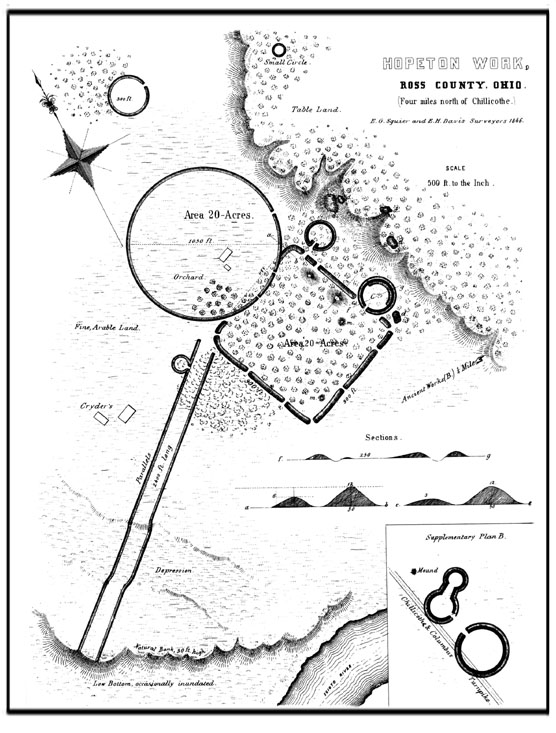
Historic map of the Hopeton Earthworks.
Large circle in Ohio


Diffusionists have pointed to many links between the Old World (Africa, Asia, Europe) and the New World (The Americas), ranging from plants (includint cocaine) to various architectural styles. The most common is probably the pyramid, famous in Egypt and Mesoamerica (as well as Sudan, Peru, and other areas), but there are also artistic links, such as figures with two left hands, which appear in relief sculptures and paintings in Egypt and Mesoamerica. Here's an examination of this connection, for example:

http://members.tripod.com/~kon_artz/cultures/egyptame.htm

John Sorenson's book lists many more, including plants and architecture. Mesoamerican theorists use these links as evidence of a connection between the Middle-East and Mesoamerica. See, e.g., Wirth's book. There are links in terms of measurements as well, as Garth Norman points out here.

One link that I've so far never seen addressed by the Mesoamerican theorists is the unusual creation of large circles in the Middle East (mainly Jordan) and in North America (mainly Ohio area). The Jordanian circle in the photo above is 1,280 feet in diameter. The Ohio circle in the photo above is about 1,050 feet in diameter. There are at least five such circles in Ohio that are around 1,500 feet in diameter, along with several other sophisticated earthworks.

What all this tells me is that there may have been ancient cultural exchanges between Mesoamerica and Egypt/Babylon/Assyria, (but of course there are many critics of diffusionism generally and in Mesoamerica specifically). In terms of the Book of Mormon, none of these links are required or prohibited by the text. They are simply and completely irrelevant, other than to establish the plausibility of a transatlantic voyage by ancient people.

What the text does require, however, is a connection between Israel/Jordan and the Book of Mormon lands, in terms of language, observing the Law of Moses, building temples, and other cultural elements. In Ohio, we know that some of these earthworks were used as observatories. Others we don't know the purpose of. We don't know the purpose of the circles in Jordan, either, but it will be interesting to follow the research.

According to the Smithsonian Magazine:

These Giant Circles in the Mideast Are One of the World's Last Mysteries

Archaeologists have found more than a dozen ancient circles in Turkey, Syria and Jordan—but don’t know why they were built

Read more: http://www.smithsonianmag.com/smart-news/these-giant-circles-mideast-are-one-worlds-last-mysteries-180953237/#yZoCVKV7QUoWqosQ.99
Give the gift of Smithsonian magazine for only $12! http://bit.ly/1cGUiGv
Follow us: @SmithsonianMag on Twitter


Joseph didn't know the Book of Mormon?

Here is the kind of conclusion one eventually reaches by following the Mesoamerican theory:

 Believe it or not, I don't think JS knew the BofM very well. I read somewhere that he never quoted from it when giving his many speeches. He was not the book's author and I think it took some years after the translation for him to realize it took place in a relatively small area.

That's a quotation from a Facebook post by Doug Christensen, the President of the "Book of Mormon Archaeological Forum," a group of Mesoamerican theorists. He posted it in a closed FB group so you have to be a member to read their posts. I don't know of Mr. Christensen has announced his position publicly, but it is implicit in all of his comments on the topic, as well as the comments by others who write for the BOMAF.

Throughout my discussions with Mesoamerican advocates, I've found them to be highly defensive about their critiques of Joseph Smith's writings and sayings, as well as his mother's biography and the journals of his close associates and contemporaries. They dismiss every reference (including in the D&C) that supports a North American setting for the Book of Mormon, instead favoring three short articles in the Times and Seasons that lack a byline or signature. They resort to incomplete wordprint analysis to assert that Joseph Smith wrote these three articles. I'll address each of these points in separate posts, but for now, anyone following the debate must be aware that the Mesoamerican theory will lead you directly to the same destination that Mr. Christensen has reached; i.e., you will have to conclude that Joseph Smith did not know the Book of Mormon very well.

Realize, too, that BOMAF has several emeritus General Authorities on their Advisory Board:
Elder Ted E. Brewerton, Emeritus General Authority
Elder Robert E. Wells, Emeritus General Authority
Elder Merrill C. Oaks, Former General Authority
Elder Clate W. Mask, Former General Authority

So far as I know, they have not publicly agreed with Mr. Christensen's belief that Joseph didn't know the Book of Mormon very well, but by virtue of their association with BOMAF, one can only infer they do agree.

Here is the post in context (at the bottom of this excerpt). I've deleted the name of all the participants other than Mr. Christensen.

Hey gang. I'm new to this page. I've subscribed to the Meso American model for decades. One question. What were Nephites doing so far north in Joseph Smith's backyard? I found this in the Joseph Smith Papers:
"...After we left the eastern part of the State of Ohio we could get provision on an average as follows; flour by the hundred $1.50, bacon from 4½ to 6 dollar per Hundred butter from 6 to 8 cents pr pound, honey from 3 to 4 shilling the gallon, new milk from 3 4 to 6 ct per gallon. The whole of our journey, in the midst of so large a company of social honest men and sincere men, wandering over the plains of the Nephites, recounting occasionaly the history of the Book of Mormon, roving over the mounds of that once beloved people of the Lord, picking up their skulls & their bones, as a proof of its divine authenticity... Joseph Smith, Jr
A group of approximately 205 men and about 20 women and children led by JS to Missouri, May–July 1834, to redeem Zion by helping the Saints who had been driven from Jackson County, Missouri, regain their lands; later referred to as “Zion’s Camp.” A 24 February...
JOSEPHSMITHPAPERS.ORG
Like ·  · 

  •  My ancestor started in New Jersey in 1710 to explore the continent. He when down the eastern sea board to Mexico before wandering north to the Canadian arctic. He was a real adventurer and was in many places before any other Europeans. He is best know as a fur trader living with the Canadian natives. Is it such a surprise that adventurous Meso Americans would also travel and explore.
  •  There is quite a bit of evidence of Mayans travelling northward to these areas during BOM times.http://bmaf.org/.../mesoamerican_travels_northward...
  • Doug Christensen delete "these areas" to make it accurate. From Tyler's article listed above: "Although we cannot identify these movements with the Book of Mormon account specifically, we can see that the kind of migrations northward mentioned in the Book of Mormon are substantiated in general."
  •  More evidence of travelling all over the continent. Seems they did get around. Scroll down for a couple interesting maps and anecdotes.

    http://rsc.byu.edu/.../18-moroni-last-nephite-prophets


    You can view the latest Review magazine online,...
    RSC.BYU.EDU
  •  I can't believe Joseph would lie to Emma like that! J/k. I tend to assume Joseph was just wrong on this statement ( and possibly the Zelph one too). His understanding of the BOM geography grew as time went by. I many times on my mission of the land southward (South America) and land northward (noth America) hemispheric model which I now understand to be completely incorrect. But that's just my opinion though.
  • I like the hinterland theory that the book of mormon society including all of north and south America with major portions of the book being in certain locations.
    7 hrs · Like
  • I'm starting to conclude that JS generally believed that the BoM happened over all of North and South America...which I can understand due to their lack of science and anthropology at that time. It didn't make the BoM less true...just their understandi...See More
    5 hrs · Like
  • Doug Christensen You're exactly right ______. JS knew that the promised land encompassed all of North and South America, but it was never revealed to him exactly where the Nephites/Lamanites lived. For him, it was a guessing game and he was not afraid to make his guesses known. Occasionally he even blended the chronology of cultures and was severely criticized by his critics for it. See: "An Analysis of Joseph Smith’s Statements Associated with the Origins of the Aztecs in the Country of Aztlan"http://www.bmaf.org/arti.../analysis_aztecs_aztlan__stoddard It was not until he was sent the Stephens/Catherwood book that he perhaps recognized from the drawings things he had seen in vision as a young man. Believe it or not, I don't think JS knew the BofM very well. I read somewhere that he never quoted from it when giving his many speeches. He was not the book's author and I think it took some years after the translation for him to realize it took place in a relatively small area.