Ideas conquered long ago

Long ago, Joseph Smith and Oliver Cowdery conquered false claims that the Book of Mormon was fiction or that it came through a stone in a hat. But in recent years certain LDS scholars have resurfaced the false claims. To conquer them again, we have to return to what Joseph and Oliver taught.

Tuesday, November 7, 2017

Confusing messages at the MTC

National flags at Provo MTC
A few months ago I toured the MTC in Provo, a wonderful campus that trains thousands of missionaries to go into the world to teach about the Restoration and bring people to Christ.

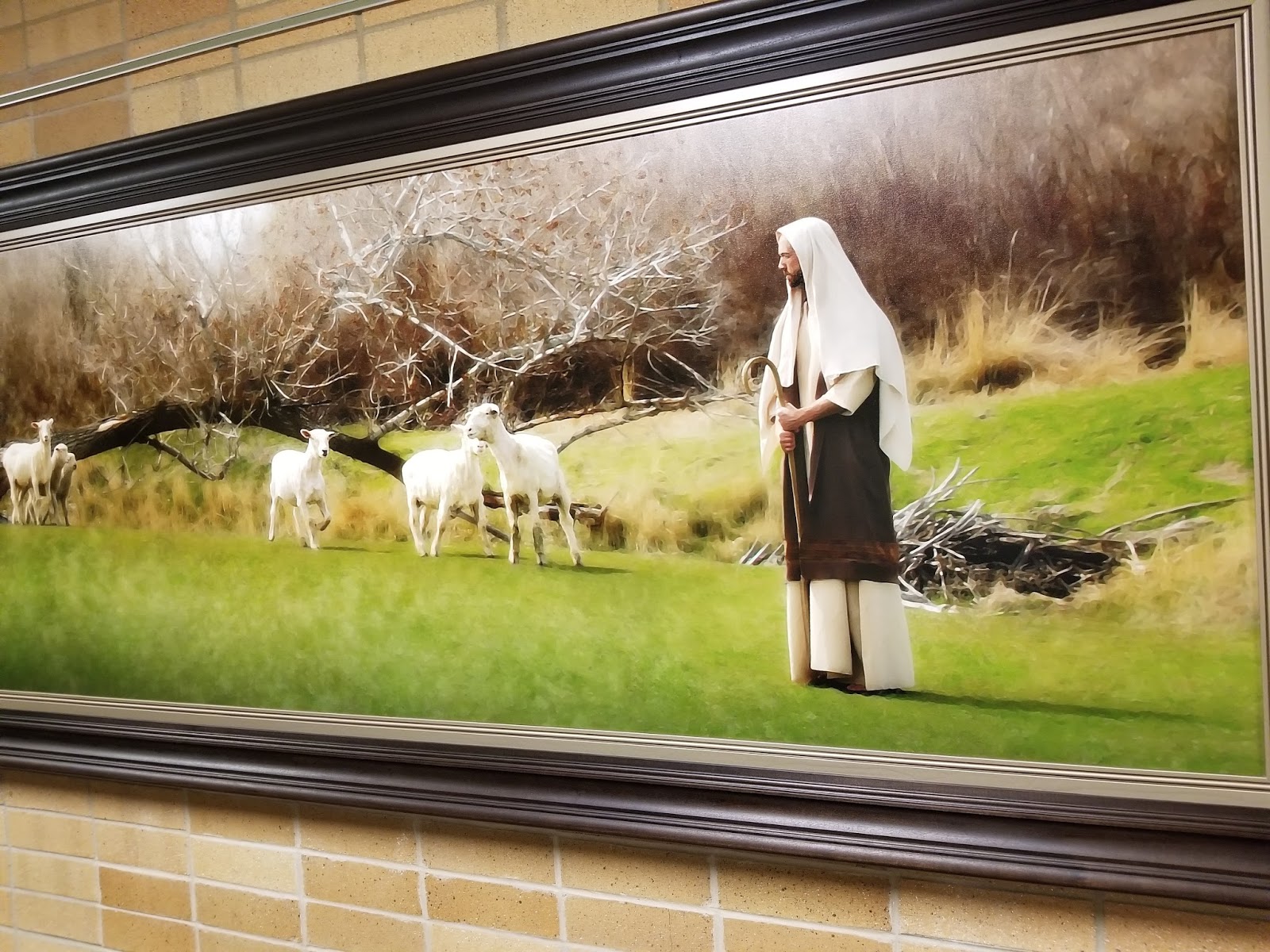
The campus is beautifully decorated with inspiring art and murals, such as these:


Some of the murals depict prophets, apostles, and missionaries in various settings. Here's one of Nephi in the Old World, for example:


Buildings are named after famous missionaries, such as LeGrand Richards, who taught that the Hill Cumorah was in New York.

"It was at this time that Mormon deposited in the Hill Cumorah all the records that had been entrusted to him except a few plates that he gave to his son Moroni. (See Mormon 6.) About A.D. 420, Moroni placed these plates with those his father, Mormon, had already deposited in the hill. (See Moroni 10:1-2.)" A Marvelous Work and a Wonder, p. 73.

Another building is named for Parley P. Pratt, who also taught that Cumorah is in New York.

"This Book, which contained these things, was hid in the earth by Moroni, in a hill called by him, Cumorah, which hill is now in the State of New York, near the village of Palmyra, in Ontario County.” Autobiography of Parley P. Pratt, p. 43.

The administration building is named for Wilford Woodruff, who among other things taught that Cumorah was in New York:

"[Joseph] went [into] a Cave in the Hill Comoro with Oliver Cowdry & deposited those plates upon a table or shelf. In that room were deposited a large amount of gold plates Containing sacred records...  Joseph Smith said that Cave Contained tons of Choice Treasures & records." 

Another building is named after Heber C. Kimball, who also taught that Cumorah was in New York:

"Joseph and others... went into a cave in the hill Cumorah, and saw more records than ten men could carry... There were books piled up on tables, book upon book. Those records this people will yet have, if they accept of the Book of Mormon and observe its precepts, and keep the commandments."

There is a building named after Edward Stevenson, who also taught that Cumorah was in New York:

"At one time a fierce battle was fought near where Buffalo, N.Y., now stands, wherein two million were lying strewn upon the earth, slain in battle and no one to bury them, till the stench drove them southward to the Hill Ramah, which was called Cumorah by the Nephite race."

Stevenson also related David Whitmer's statement that Oliver and Joseph had visited the room in Cumorah that contained the portion of gold plates not yet translated, etc.
______________

Missionaries studying in these MTC buildings are never told that the men for whom the buildings are named taught that there is one Hill Cumorah and it is in New York. 

They are never told that Joseph Smith and Oliver Cowdery taught the same thing.

The missionaries are never told that members of the First Presidency, speaking in General Conference, have reaffirmed this basic teaching.

Instead, they are subjected to images of Mesoamerica.

Probably the most famous one is this:

The sons of Mosiah depicted in Guatemala


I zoomed in on the image so you can see the destination for the "sons of Mosiah."

Mayan pyramid city, the destination for the "sons of Mosiah."
It's a Mayan city of stone pyramids, reflecting the Mesoamerican/two-Cumorahs theory promoted by LDS intellectuals who have repudiated the consistent teachings of modern prophets and apostles.

There are other depictions of Mesoamerica in the MTC that I won't show here.

And there are exactly zero depictions of Cumorah in New York.
_____

I've been told by multiple sources that around 40% of returned missionaries leave the Church or go inactive after their missions. I can't independently verify that statistic, but that's about the percentage of my own missionary companions who have left the Church.

Imagine being a missionary at the Provo MTC, studying and eating and living in buildings named for valiant missionaries you want to emulate.

But only after you get into the mission field, or after you get home, do you learn that the setting for the Book of Mormon you were taught--a setting promoted by LDS intellectuals and reinforced by Church media and even the artwork in the MTC--repudiated the teachings of the very men for whom those buildings were named.

Imagine how you would feel to have believed and taught this Mesoamerican/two-Cumorahs theory, only to later discover Letter VII's explicit, detailed teaching about the New York Cumorah and all the supporting statements by prophets and apostles for over 150 years.

You would feel you've been lied to misled at the MTC, at BYU, in CES, and even in your Church classes.

At a minimum, you would feel confused and disturbed, as Joseph Fielding Smith warned when he discussed this Mesoamerican/two-Cumorahs theory.

But for many such missionaries, they lose their faith in the Book of Mormon, and that leads them out of the Church or into inactivity.

All because LDS intellectuals insist on promoting their pet theories, even to the point of telling the youth--and the missionaries--that the prophets and apostles are wrong.
_____


Monday, November 6, 2017

How intellectuals "prove" their theories

The intellectuals in the Church who support the Mesoamerican/two-Cumorahs theory have a final argument they are making.

They openly acknowledged that they repudiate every prophet and apostle who has spoken about Cumorah for the last 150 years.

They also admit that while they insist their interpretation of the text is the "correct" one, they can't agree among themselves about such basics as the location of Cumorah, the narrow neck of land, or even the river Sidon.

Nevertheless, they insist the Church has endorsed their position because of Church art.

They sometimes state that the Church is "neutral" on Book of Mormon geography, but they wink at that because they, like everyone else, know the Church's media department has depicted the Mesoamerican/two-Cumorahs theory since at least 1981.

Here's a graphic that shows the cycle:


Here's how it works.

1. Mesoamerican advocates such as the old FARMS (morphed into the Interpreter), FairMormon, BMAF, and now BMAF's corporate subsidiary Book of Mormon Central (BOMC), develop a theory of Book of Mormon geography that repudiates the prophets and apostles by insisting that the Hill Cumorah (Mormon 6:6) "cannot" be in New York.

Instead, these intellectuals persuade themselves that Joseph Smith, Oliver Cowdery, and all of their contemporaries and successors were ignorant speculators who misled the Church about Cumorah's location. This includes members of the First Presidency speaking in General Conference.

2. The intellectuals teach the Mesoamerican/two-Cumorahs theory to students at BYU and in CES. Lately, they've begun presenting the Mesoamerican/two-Cumorahs theory as an "abstract map" based on the standard Mesoamerican interpretation of the text.

I've blogged about this here:
http://bookofmormonwars.blogspot.com/2017/08/alarming-news-from-byu-education-week.html,
here:
http://bookofmormonwars.blogspot.com/2017/04/update-on-abstract-maps.html
and here:
http://bookofmormonwars.blogspot.com/2016/06/abstract-maps-revisited.html

Obviously, this abstract map is a ruse to evade the new prohibition at BYU against using a real-world geography. Except it's even worse, because they're depicting Cumorah in a fantasy land. Apparently, as long as we don't show Cumorah in New York, any other geography is fine to teach at BYU/CES now.

3. With the Mesoamerican/two-Cumorahs theory firmly imprinted on their minds by teachers they trust, these BYU/CES students graduate and enter the workforce. Some become artists; others become Church employees. They depict the Book of Mormon just as they've been taught by the intellectuals; i.e., as a story of people living in southern Mexico and Guatemala, the area of Mesoamerica which they claim is the location of the promised land and the great nation that would be the site of the restoration and that would fulfill Isaiah's prophecies and that would send missionaries throughout the world, etc.

4. The Mesoamerican/two-Cumorahs artwork and media gain widespread acceptance in the Church by default, including the two-Cumorahs display on Temple Square in the North Visitors Center and the illustrations in the missionary edition of the Book of Mormon itself.

Then the Mesoamerican proponents use this artwork and media as evidence that the Church approves their theory.

Tomorrow I'll give a recent example of this approach.

Brilliant plan, isn't it?

Except in my opinion, teaching students that the intellectuals are right and the prophets and apostles are wrong is exactly the opposite of what these BYU/CES faculty should be doing.

This plan, well-executed by the intellectuals, is based on a premise that I question.

They claim the Brethren (meaning the highest leaders of the Church) have approved of this artwork because of its content; i.e., that the Brethren endorse the Mesoamerican/two-Cumorahs theory.

Maybe that's the case.

But the premise relies on this basic assertion: that the Brethren have repudiated all prior prophets and apostles who have spoken about Cumorah in New York without a more official statement than a series of artists' conceptions.

Instead, at least in my opinion, the far more likely explanation is that the Brethren delegate the artwork to experts whom they trust because they were educated by BYU/CES. To the extent the Brethren "approve" this artwork, it is not because they are making an official statement about the Church's position on the Hill Cumorah.
_____

That said, the impact of this artwork and media is powerful. In my view, it has misled generations of youth, missionaries, investigators, and even mature members of the Church. It is the fulfillment of Joseph Fielding Smith's early warning that because of this theory, members of the Church would become confused and disturbed in their faith in the Book of Mormon.

These intellectuals are teaching their students to believe them, the intellectuals, whenever their opinions differ from what the prophets and apostles have said. This problem extends far beyond the question of Cumorah, of course, but this is a specific application that everyone can see and that the intellectuals openly admit.
_____

BTW, I think the Brethren also rely on the expertise of the intellectuals who are trusted enough to teach at BYU/CES. At least, that's what the intellectuals have told me.

The fact that these intellectuals have not informed the Brethren about all the facts, or even about all the alternatives to their Mesoamerican/two-Cumorahs theory, is a serious problem that I'll be discussing more in the future.


update on watching General Conference with your BYU/CES teacher

A few days ago I posted a comment about watching General Conference with your BYU/CES teacher. http://bookofmormonwars.blogspot.com/2017/10/watching-general-conference-with-your.html

It turns out, there are some BYU/CES teachers who support and sustain the united and consistent position of the prophets and apostles who have spoken about the New York Cumorah for over 150 years.

These teachers just are not well known because the people who control FairMormon, Book of Mormon Central, BYU Studies, the Interpreter, the Maxwell Institute, and Meridian Magazine don't allow them to publish or even comment about their beliefs. As we all know by now, those groups censor anything that threatens their Mesomania editorial stance.

There are also many Church employees who support and sustain the prophets and apostles.

A reader sent in this correction.

Well I don't know about Church employees who work for public relations, media, magazines, etc., but as a Church employee in the Family History Department (and formerly in the ICS department), I can tell you there are a LOT of employees and senior missionaries who are completely on board with what the prophets and apostles have said about Cumorah. It has been my experience (repeatedly) that they recognize the truth when they hear it, just as they did when first reading the Book of Mormon--it resonates in their souls.

I have yet to meet anyone who sincerely studied the Heartland Model who rejected it. All those I have met who still wallow in Mesomania have never given any serious thought to the Heartland and the research done about it, except for scholars whose livelihood and reputation rely on the furthering of their Mesoamerican pseudo-theory.

I appreciate this comment and I apologize to any Church employees who I inadvertently may have lumped in with Mesoamerican advocates. I know of many Church employees who support and sustain the prophets and apostles regarding the New York Cumorah.

The problem really is with a handful of intellectuals who run FairMormon, Book of Mormon Central, BYU Studies, the Interpreter, and the Maxwell Institute, as well as some faculty at BYU and CES who contribute to and support those groups. These people are determined to continue foisting the Mesoamerican dogma on their students and readers, as they have been doing for decades. They openly repudiate the prophets and apostles about the New York Cumorah, which, in my opinion, is a breach of their fiduciary responsibility as teachers at BYU/CES.

I also agree with the reader's comment about those who assess the two scenarios with an open mind. You will notice if you engage in any discussions with Mesoamerican proponents that they have a Groupthink interpretation of the text that drives everything they think, say, and write. Even though they can't agree among themselves, they insist their interpretation is the only viable one, and their Groupthink is so powerful they have no problem repudiating the prophets and apostles whenever they contradict their Mesoamerican dogma. 

Few Church members (apart from the Mesoamerican proponents) knowingly reject the prophets and apostles. 

That's why the Mesoamerican proponents refuse to publish any fair comparisons between the North American and Mesoamerican settings. They don't want Church members to realize how fully they have repudiated the prophets and apostles regarding the New York Cumorah.

From the outset of this blog, I've freely and openly linked to the Mesoamerican proponents' publications. I want more Church members to realize what these intellectuals are teaching our youth. I don't think their sophistry can withstand even cursory scrutiny, but they have been getting away with it for years because they control the "scholarly" publications.

I invite those who have seen through the fog of the Mesoamerican arguments to speak out more openly. I think we'll find that the vast majority of members of the Church support the prophets and apostles, and they reject the intellectuals once they realize what has been going on.

Friday, November 3, 2017

Why the scholars stick with Meso

the restored house in which Joseph translated the Harmony plates
I've been in upstate New York for a few days. Here's a photo I took at the Aaronic Priesthood Restoration Site in Pennsylvania.

This is one of my favorite Church history sites for several reasons, but one is the humble nature of the location where Joseph and Oliver translated the Harmony plates. It's pretty cool to think that the book which is destined to change the world was translated in such an unassuming and remote area.

And it's a stark contrast to the great and spacious intellectual buildings from which our LDS educators teach our youth to disbelieve what Joseph and Oliver said about Cumorah; i.e., that it was a fact that the final battles of the Jaredites and Nephites took place in western New York.
__________

A lot of people wonder why our LDS scholars stick with their Mesoamerican/two-Cumorahs theory.

I've addressed this before, such as in my book Mesomania and in several blog posts, but here's another angle to consider.

Our educators are unlikely to change their minds about Cumorah until their friends do. It's not a matter of facts or rational thinking; it's a matter of peer pressure, groupthink and psychology.

At this point, they have a fortress or seige mentality. Their barricade consists of a system of intertwined publications  that includes Meridian Magazine, BYU Studies, the Intepreter, FairMormon, BookofMormonCentral, BMAF.org, and related groups (what I used to call the "citation cartel").

They use these outlets to reinforce and comfort one another by repeating the same basic premises. They all think alike, and that's why they formed these publications and web pages that refuse to let readers know what the prophets and apostles have taught.

The greatest risks to their ideology come from (i) members of the Church who read Letter VII and the general conference addresses about Cumorah and (ii) members of the Church who actually believe the prophets and apostles.

Just in the last week I've seen some of this fortress mentality at work .

Anyone who walks into a visitors center will see displays that teach the two-Cumorahs theory, as I've shown many times.

It is tragically unimaginable, and yet true, that the hundreds of thousands of people who have visited the Hill Cumorah in the last few years have left without even learning what Joseph and Oliver said about that sacred site (apart from edited comments about the stone box*).

Why?

Because of the Mesoamerican/two-Cumorahs dogma that our intellectuals have foisted on their students--students who have grown up to become Church employees who implement the dogma through every channel possible.

My post about watching General Conference with your BYU/CES teacher had a lot of readers, but not enough. I think every student at a BYU campus or in CES should be aware that their instructors reject the teachings of the prophets and apostles about the Hill Cumorah. I think every parent and donor should know this as well.

But don't think these instructors who support the Mesoamerican/two-Cumorahs theory are going to change their opposition to the prophets and apostles just because students ask questions.

As many readers here have observed, it is difficult to understand how these educators justify their position. Mostly they do it by claiming that Cumorah "cannot fit" their imaginary "requirements" for Cumorah, such as the "requirement" that there be volcanoes in the area and their imaginary belief that there are no artifacts in New York that corroborate what Joseph and Oliver taught.

Our intellectuals rely on their own learning. Like the great and spacious building of Lehi's dream, these intellectuals have no foundation except their own imagination. Because they have rejected the ordained prophets and apostles, they stand "as it were in the air, high above the earth."

They even mock those who believe the prophets and apostles, as I pointed out in that post.

The Mesoamerican/two-Cumorahs theory is among the best examples of this basic principle: "When they are learned they think they are wise, and they hearken not unto the counsel of God, for they set it aside, supposing they know of themselves, wherefore, their wisdom is foolishness and it profiteth them not." (2 Nephi 9:28)

Most members of the Church know that we "receive no witness until after the trial of [our] faith" (Ether 12:6). Those who trust and have faith in the words of the prophets and apostles receive the witness that what they teach is true.

As long as our intellectuals distrust the prophets and apostles, they will continue to be "ever learning, and never able to come to the knowledge of the truth." They will continue taking expeditions to southern Mexico in a search for their imaginary Cumorah; they will continue debating over which Mesoamerican river is the Sidon; and they will continue searching for a "narrow neck of land" that they think is the same as a narrow neck and a small neck, etc.

Meanwhile, members of the Church and investigators will continue to visit Cumorah in New York and be kept in ignorance about the significance of that location as taught by Joseph, Oliver, and all of their contemporaries and successors.

_____

*No visitors center that I know of shows visitors quotations from Letter VIII, the most detailed description of Moroni's stone box that we have.


Wednesday, November 1, 2017

Sympathy for unbelievers at BYU, FairMormon, etc.

NOTE: This is an edidted cross-post from the Consensus blog, here.
_____

One way to obtain consensus is through sympathy and understanding for opposing viewpoints.

We might think that most people, given the same information and background, would reach the same conclusions. However, our beliefs depend on the filters through which we perceive information. If you put on the filters of someone who has taught the Mesoamerican theory his/her entire life, you would probably see things the same way that person does.

It's extremely difficult to admit you have taught false theories to thousands of faithful Latter-day Saint youth.

But having done so, you have even greater responsibility to correct the mistake.

Especially when you're still teaching them!

I propose that a more sympathetic understanding of others' views could lead to a consensus, so long as people are willing to rethink their positions.
___________________

By now, it is well known that the Mesoamerican theory of Book of Mormon geography is based on the premise that Joseph Smith and Oliver Cowdery were wrong about Cumorah in New York.*

In other words, our LDS intellectuals who still teach the Mesoamerican/two-Cumorahs theory disbelieve what Joseph and Oliver taught in Letter VII. That's why I refer to them as unbelievers.

"Unbelievers" in this context is not intended as a pejorative label. It's purely a description. And the promoters of the Mesoamerican setting don't disagree with it.

They openly admit they don't believe Letter VII.

I've outlined the history of Mesomania before, such as here, but today I want to emphasize that we should have sympathy and patience for the unbelievers among us.

Put yourself in their places. They have been teaching the Mesoamerican setting for decades. They have even ridiculed those who accept what Joseph and Oliver taught about Cumorah. For example, John Sorenson, in his oft-quoted and admired book Mormon's Codex, goes so far as to say that what Joseph and Oliver taught is "manifestly absurd."

These faithful, well-meaning LDS scholars and educators have taught generations of Latter-day Saints to think the Book of Mormon took place in Mesoamerica. We should not criticize them for what has happened in the past.

We're trying to thread the needle here by focusing on the present and the future. To do so, we have to explain how we got to this point, but we don't criticize the intellectuals for what they've taught before.

Instead, we are sympathetic and understanding. They thought they were doing the right thing, and their influence is pervasive.

But now they know better. 

Or at least most of them do.

They are experiencing cognitive dissonance, as I explained in this cartoon:

Mesomania scholar encounters Letter VII - h/t Scott Adams
We can be sympathetic and understanding regarding the past, and acknowledge the difficulty of dealing with cognitive dissonance.

But at this point, every time someone teaches the Mesoamerican theory (as well as the "abstract map" at BYU which teaches the Mesoamerican theory by applying the Mesoamerican interpretation of the text to a fantasy map), he or she is knowingly teaching LDS youth that Joseph and Oliver were wrong.

I think it is inexcusable for anyone to continue teaching that Joseph Smith and Oliver Cowdery were wrong about Cumorah. 

And anyone who is teaching that the real Cumorah of Mormon 6:6 is not in New York is teaching that Joseph and Oliver were wrong.

When fully informed, most LDS students, missionaries, and ordinary members side with Joseph and Oliver instead of our LDS scholars and educators who claim Joseph and Oliver were wrong.

The scholars know this. That's why they have refused to tell their students and readers about Letter VII and the related context.

If the scholars and educators who teach the Mesoamerican/two-Cumorahs theory want to continue to believe that theory, fine. If the people at FairMormon, Book of Mormon Central, BYU Studies, the Interpreter, Meridian Magazine and the rest want to continue to believe Joseph and Oliver were wrong, fine.

But they should no longer impose that theory on their students.

And they should no longer suppress what Joseph and Oliver taught.

They should not seek to skirt the issue by using a fantasy map that incorporates the Mesoamerican interpretation of the text and shows Cumorah outside of the real-world New York.

Every LDS scholar and educator has, at a minimum, a duty of full disclosure.

They should tell their students about Letter VII and its historical context so students can make fully informed decisions. They should tell their students that all of Joseph's contemporaries, and all of his successors who have discussed the topic, including members of the First Presidency in General Conference, have affirmed that there is one Cumorah and it is in New York.

The Mesoamerican advocates can continue to say the prophets and apostles are wrong, but they should no longer hide the facts from their students.
__________________

*A basic tenet of Mesomania is that Joseph and Oliver were ignorant speculators who misled the Church when they taught Cumorah was in New York. Instead, according to Mesomaniacs, there are "two Cumorahs." The "real Cumorah" is somewhere in Mexico. The one in New York was named by mistake out of ignorance and speculation by unknown early Church members (possibly Oliver Cowdery) and then Joseph Smith adopted this false tradition. Mesomaniacs think every prophet and apostle who has identified Cumorah as the hill in New York, including members of the First Presidency speaking in General Conference, were also wrong and therefore also misled the Church.

Monday, October 30, 2017

Contributing to Book of Mormon Central

Many people are receiving fund-raising emails from Book of Mormon Central.

Here's my advice.

Tell them you will donate as soon as they do at least these two things: 

(1) give readers a full explanation of the North American setting (Moroni's America and the Heartland) as an alternative to their Mesomania; and

(2) explain clearly why they reject what Joseph Smith, Oliver Cowdery, and all their contemporaries and successors have taught about the Hill Cumorah being in New York.
______________

Look at their logo and you'll see confirmation of their corporate mission "to increase understanding of the Book of Mormon as an ancient Mesoamerican codex." 

I don't think this mission deserves one penny of support because, as Joseph Fielding Smith warned, it causes members of the Church to "become confused and greatly disturbed in their faith in the Book of Mormon." In my view, this mission undermines all the good that Book of Mormon Central otherwise does. It's a major impediment to missionary and reactivation work.

Unless and until Book of Mormon Central changes its editorial policy on Cumorah, we should continue to consider them Book of Mormon Central America because they are not representing all faithful Book of Mormon evidence, studies, or scholarship.

Here's what their email looks like, complete with the famous logo depicting Mayan culture along with Hebrew, Greek and Egyptian.

Book of Mormon Central
Friends,

Book of Mormon Central has many exciting projects planned for the next year, and we need your help. Please consider a donation to Book of Mormon Central this season. The Book of Mormon is a cause worth supporting. Please share this email with family and friends. Scroll down for more information.

Kind Regards,
John W. Welch
Chairman
Kirk A. Magleby
Executive Director
Taylor Halverson
Board Member
Ruth Schmidt
Board Member
Scott Petersen
Board Member
Bob Babcock
Board Member
Click to Donate
PO Box 1538, American Fork, UT 84003-6538bookofmormoncentral.org

Sunday, October 29, 2017

Watching General Conference with your BYU Book of Mormon professor

Note: this is an administrative experiment. It's the same post from Friday.
__________________

Imagine you are attending or watching General Conference with your BYU Book of Mormon professor or your CES instructor in seminary or Institute.


President Uchtdorf speaks. He says this:

"In the western part of the state of New York near Palmyra is a prominent hill known as the “hill Cumorah.” (Morm. 6:6.) On July twenty-fifth of this year, as I stood on the crest of that hill admiring with awe the breathtaking panorama which stretched out before me on every hand, my mind reverted to the events which occurred in that vicinity some twenty-five centuries ago—events which brought to an end the great Jaredite nation....

"As the conflict intensified, all the people who had not been slain—men “with their wives and their children” (Ether 15:15)—gathered about that hill Cumorah (see Ether 15:11)....

"Thus perished at the foot of Cumorah the remnant of the once mighty Jaredite nation, of whom the Lord had said, “There shall be none greater … upon all the face of the earth.” (Ether 1:43.)

"As I contemplated this tragic scene from the crest of Cumorah and viewed the beautiful land of the Restoration as it appears today, I cried in my soul, “How could it have happened?”
...
"The tragic fate of the Jaredite and the Nephite civilizations is proof positive that the Lord meant it when he said that this “is a land of promise; and whatsoever nation shall possess it shall serve God, or they shall be swept off when the fulness of his wrath shall come upon them. And the fulness of his wrath cometh upon them when they are ripened in iniquity.” (Ether 2:9.)"

When President Uchtdorf finishes, you turn to your professor and say, "That was awesome. Food for thought. We should discuss this in class."

Your professor replies, "Not so fast. He was merely expressing his opinion. And he was wrong. Cumorah is not in New York. It's in Mesoamerica. Or it's in a fantasy land, as we show on our 'internal map' here at BYU. It's anywhere except New York."

You are stunned. "But he just said it was in New York. He stood on the hill where the final battles took place."

"Yes," your professor says, "he did say that. But he was wrong, I tell you. Haven't you read BYU Studies? Or the Interpreter? Or Meridian Magazine? Or FairMormon? Or Book of Mormon Central? All the scholars agree that the prophets and apostles who have said the Hill Cumorah was in New York were wrong."
_____

President Marion G. Romney
President Uchtdorf, Second Counselor in the First Presidency, has not given that talk. But a previous Second Counselor in the First Presidency did. President Marion G. Romney was Second Counselor in the First Presidency to President Harold B. Lee and President Spencer W. Kimball. He gave the talk I quoted above in the October 1975 General Conference. You can see it here:
https://www.lds.org/general-conference/1975/10/americas-destiny?lang=eng

If you're a BYU student now, or have been a BYU student any time in the last few decades, your Book of Mormon professor will tell you exactly what our professor said in this scenario.

They all think the prophets and apostles are wrong about Cumorah being in New York.

If I'm wrong about that--if there are any BYU Book of Mormon professors who teach--or who even believe--that Cumorah is in New York--then I'd like to know about it.

Because right now, they're teaching students that Cumorah is anywhere but in New York.
_____

Now, let's continue with General Conference. The next speaker is Elder Bednar. He says this:

"Moroni’s father was commander of the armies of this ancient people, known as Nephites. His name was Mormon. The war of which we speak took place here in America some four hundred years after Christ. (See Morm. 6.)

"As the fighting neared its end, Mormon gathered the remnant of his forces about a hill which they called Cumorah, located in what is now the western part of the state of New York.

"Their enemies, known as Lamanites, came against them on this hill....

"When finished with the record, Moroni was to hide it up in that same Hill Cumorah which was their battlefield. It would come forth in modern times as the Book of Mormon, named after Moroni’s father, the historian who compiled it."

You turn to your professor and say, "Are you saying Elder Bednar was wrong, too?"

Your professor faces you. "Sad to say, yes. He was merely expressing his opinion. And he was wrong. Didn't I just explain what all the scholars say?"

"But don't you teach us to heed the words of the apostles?"

Your professor is losing patience. "Yes, but not when they are expressing their own opinions. In that case, we are free to disagree with them."

"How do we know when they are merely expressing their opinions?" you ask.

"That's easy." Your professor smiles. "Whenever they disagree with the consensus of BYU/CES scholars, they are expressing their opinions. And in this case, they are wrong. Cumorah cannot be in New York."
Elder Mark E. Petersen of the Twelve
_____

Elder Bednar hasn't given the talk I quoted above. But Elder Mark. E. Petersen of the Twelve did, in the October 1978 General Conference. https://www.lds.org/general-conference/1978/10/the-last-words-of-moroni?lang=eng
_____

Another rhetorical tactic your BYU/CES educators will try is to say "The Brethren haven't spoken on this recently."

What they're saying is, 150 years of consistent teaching about Cumorah in New York is not enough. 

They're trying to tell you that the Lord has to repeat things every X number of years, or we are free to reject what the prophets and apostles have taught.

My question is, why keep any records at all? Why have the scriptures, or the General Conference reports, or the records of what Joseph and Oliver and other prophets and apostles have taught, if we aren't supposed to heed them after X number of years?

And how do we come up with the X number of years? Is this in the Handbook of Instructions? Or did a committee of scholars arrive at X because they disagree with teachings that are more than X number of years old? What is the cut-off for ignoring what past prophets and apostles have taught?

In my view, 150+ years of consistent teachings on a specific topic is more than enough for us to "heed the words of the twelve." To insist that the Lord repeat the teaching periodically evinces a lack of faith.
_____

The next time some BYU or CES educator tries to tell you that the Book of Mormon took place in Central America, ask whether he/she heeds the words of the prophets and apostles.

If he/she says yes, ask about the New York Cumorah, beginning with Letter VII and continuing through General Conference.

They will tell you what the professor in my scenario said; i.e., that we heed the prophets and apostles except when they are expressing their opinions, and we know they're expressing their opinions when the intellectuals disagree with them.

Then it's up to you to decide whom to believe.
__________

Since at least 1835, the prophets and apostles have consistently taught that Cumorah is in New York. It wasn't until the 1920s that scholars began teaching that the prophets and apostles were wrong.

Now, in 2017, our LDS intellectuals have pretty well universally rejected the prophets and apostles on this important issue. 

One has gone so far as to ridicule people who believe the prophets and apostles--as well as the prophets and apostles themselves.

BYU Professor John L. Sorenson, in Mormon’s Codex (Deseret Book, 2015), p. 688, writes “There remain Latter-day Saints who insist that the final destruction of the Nephites took place in New York, but any such idea is manifestly absurd. Hundreds of thousands of Nephites traipsing across the Mississippi Valley to New York, pursued (why?) by hundreds of thousands of Lamanites, is a scenario worthy only of a witless sci-fi movie, not of history.”

This ridicule of those who believe the prophets and apostles was published by Deseret Book and the Neal A. Maxwell Institute for Religious Scholarship at BYU.

Popular LDS intellectual and author Terryl Givens wrote the Foreword to this book, claiming "John Sorenson has again upped the ante with what will immediately serve as the high-water mark of scholarship on the Book of Mormon."

Sadly, Professor Givens is correct. Everyone who promotes the Mesoamerican/two-Cumorahs theory (or the latest iteration, the "internal map" being taught at BYU right now) agrees with Professor Sorenson on the Cumorah issue. 

Ridiculing the prophets and apostles on this topic has become the default position of our LDS intellectuals, including those teaching at BYU and CES.*
_____

* There may be faculty at BYU or CES who believe what the prophets and apostles have taught about Cumorah. If so, they are silent. Their silence may be due to peer pressure or to institutional policy, but either way, I'd like to know about any faculty who believe Cumorah is in New York. I won't name them, but I'd like to know if there is even one in the system anywhere.

The same goes for Church employees who work in media, public relations, Church magazines, etc.

So far, from all the reports I get, all BYU/CES faculty continue to teach what Professor Sorenson taught in his book; i.e., that the idea of Cumorah in New York is "manifestly absurd."

I've even been told that one BYU professor, if he knows there are students in his class who believe in the New York Cumorah, skips over his slides that promote the Mesoamerican/two-Cumorahs theory.

Occasionally I'll hear that someone is "open" to other ideas. How is one "open" to considering the possibility that the prophets and apostles were correct? In what sense does being "open" to this idea constitute heeding the words of the apostles? (3 Nephi 12:1).

It's like saying one is "open" to the idea that the Book of Mormon is an authentic history, that Joseph Smith was a prophet of God, etc.

Being "open" to the idea that the apostles have not been wrong is a euphemism for rejecting their words.

I'm also told that BYU has implemented a policy of not linking the Book of Mormon to any actual geography. Maybe that policy was intended to stop the Mesoamerican/two-Cumorahs theory, but if that was the intent, it has utterly failed because BYU is now teaching a fantasy "internal map" based specifically on the Mesoamerican/two-Cumorahs interpretation of the text, with a computer graphic that looks exactly like what most people think is South and Central America. For sure, Cumorah on this map is not in New York.

Here's a previous post on this abstract map:
 http://bookofmormonwars.blogspot.com/2016/06/abstract-maps-revisited.html