Ideas conquered long ago

Long ago, Joseph Smith and Oliver Cowdery conquered false claims that the Book of Mormon was fiction or that it came through a stone in a hat. But in recent years certain LDS scholars have resurfaced the false claims. To conquer them again, we have to return to what Joseph and Oliver taught.

Tuesday, November 12, 2019

Loserthink and M2C - part 2

The subtitle of Scott Adams' book* is "How Untrained Brains Are Ruining America." That seems far more negative than the book itself, however. A more accurate subtitle might be "How Untrained Brains Are Postponing the Golden Age."

(You need to read the book to see how Scott describes the Golden Age. It's one of the best parts of the book and should be especially interesting to Latter-day Saints who still aspire to establishing Zion.)

Loserthink is ubiquitous among humans, but there are special applications for particular groups. I discuss this briefly in a chapter in my upcoming book. The chapter is titled "Loserthink for Latter-day Saints."

Loserthink is postponing progress in many areas. If members of the Church can learn to identify Loserthink and apply it, we'll all be able to think more clearly, make informed decisions, and focus on the things that matter most.
_____

Loserthink is not limited to M2C, but the way M2C intellectuals promote and enforce M2C is a prime example of Loserthink.

A good example is the section in the book titled "Compared to Nothing."

Scott writes, "People also make the mistake of not comparing proposed plans to the next best alternative. Sometimes the best plan has big problems, but not as big as the next best plan. If you are not explicitly comparing your preferred plan to the next best alternative, you are not involved in rational thinking. But it might feel as if you are."

The accompanying illustration is a Sunday cartoon from about a year ago that shows the CEO taking credit for success because he picked the best plan from among the choices provided by the employees. Of course, the employees manipulated the CEO by offering the plan they wanted, giving as options only the worst plans they could think of, which caused the CEO to pick the plan the employees wanted.

One of my more popular and controversial blog posts addressed this cartoon.

http://www.bookofmormoncentralamerica.com/2018/12/employees-make-decisions.html

The Loserthink element is believing something is the best alternative when you haven't really compared it with anything. 

That's a key strategy of the M2C intellectuals.

The corollary, as shown in the cartoon, is keeping critical information away from decision makers.
_____

If you read the material on Book of Mormon Central's web page, you'll notice that they promote M2C without any mention of alternative views about Book of Mormon geography.

This is by design.

Some years ago we proposed working with them to develop a comparison matrix that would allow members of the Church (and friends) to compare M2C with other ideas. Some in the organization were enthusiastic, but ultimately the leaders vetoed the idea.

This is classic Loserthink.

Many members of the Church accept M2C because they assume the intellectuals have actually done a comparison of all the alternatives, but that's not the case.

Loserthink fantasy map
You can ask your CES or BYU teacher if he/she has ever compared the alternative ideas. They'll admit they haven't, and they'll say the geography doesn't matter anyway. (Of course, maybe it doesn't matter to them, but that has nothing to do with whether it matters to other people--like the vast majority of people in the world.)

If pressed, they'll say someone else has done the comparison and concluded that M2C is the best approach.

That's how we ended up with the fantasy maps from CES and BYU. It's pretty amazing, actually.

The teachers might cite the work of John Sorenson, such as Mormon's Codex, or the work of another M2C promoter. As we've discussed on this blog, that book is based on a mistaken premise that it doesn't explain and consists of a series of cascading assumptions and "correspondences" that require people to repudiate the teachings of the prophets and essentially rewrite key parts of the Book of Mormon to make it fit in Mesoamerica.

What you'll never see from Book of Mormon Central is a comparison chart.

That's because M2C is based on the Loserthink principle of comparison to nothing.

By now, readers here know why. The M2C scholars know that, in most cases, once members of the Church learn what the prophets have actually taught, they usually chose the prophets over the M2C scholars.

Of course, everyone is free to chose the scholars instead of the prophets. We don't mind if people make an informed decision to follow the scholars and repudiate the prophets.

But when there is no basis for comparison, it is Loserthink to chose the scholars by default.
_____

I created some comparison charts a few years ago and invited others, including the M2C scholars, to make comments or corrections if I misstated anything.

You can see the results in this post:

http://www.bookofmormoncentralamerica.com/2017/09/comparison-chart-and-decision-tree.html

I continue to welcome comments and suggestions for improvement. I'll probably make some myself soon.
_____

*Apparently the title page on the print version says "How Untrained Brains are Ruining the World," which is a better subtitle because America has no monopoly on untrained brains.

Monday, November 11, 2019

The Perfect Storm - Part 4

Believing the intellectuals instead of the prophets has become popular lately, but ironically, the intellectuals are far less credible than the prophets on these topics. We're seeing the natural consequences of people preferring the intellectuals over the prophets.

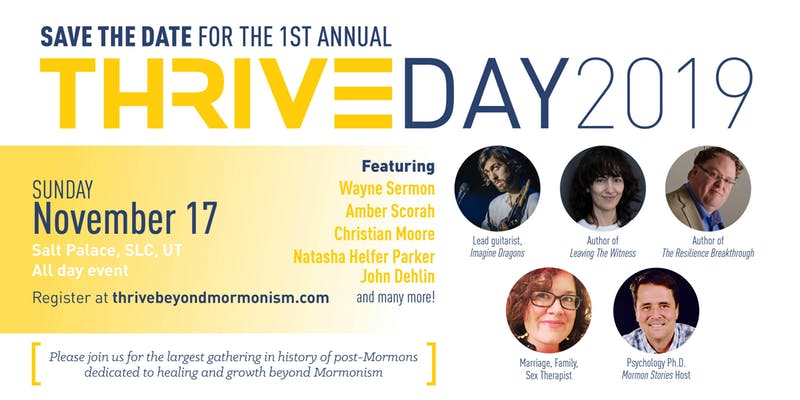
Below is an email that went out a while ago. It involves an event to take place in Salt Lake City on November 17, 2019.

Many people living in Utah are familiar with this group and its activities, but many are not. Those living outside of Utah may be less familiar with this, but in my experience, nearly every member of the Church, everywhere in the world, knows people who have left the Church for various reasons.

In very few cases does anyone leave the Church while retaining a testimony of the truthfulness of the Book of Mormon.

I include this event as part of the "Perfect Storm" series because the combination of M2C and the peep stone narrative are undercutting the basic premise for the Restoration.

That is, the Restoration is based on the premise that Joseph Smith and Oliver Cowdery told the truth about the translation of the Book of Mormon and related events. They were the sole witnesses to the translation, the restoration of the Priesthood, and the restoration of Priesthood keys in the Kirtland temple.

Modern LDS scholars who promote M2C and the peep stone narrative are teaching members of the Church to disbelieve Joseph and Oliver on key points they emphasized over and over.

This inevitably leads to an erosion of faith.

Our M2C scholars insist that Joseph and Oliver (and their successors) misled the Church about the New York Cumorah. Instead, these scholars claim the "real" Cumorah is somewhere in Mexico, with all the baggage that brings.

The revisionist historians claim that Joseph didn't really translate the plates, but instead merely read words that appeared on a peep stone he put in a hat. They are teaching this throughout the Church. Of course, that contradicts everything Joseph and Oliver ever said on the subject and questions the point of Mormon abridging the Nephite records in the first place; i.e., if Joseph didn't really translate the plates, why did everyone go to so much trouble to create and preserve them?

Joseph and Oliver specifically addressed both issues when they wrote the eight historical essays we've discussed here many times, including Letter VII. They cited facts to establish their teachings, but now these intellectuals want members of the Church to reject those facts and their teachings.

Many members of the Church reject what the M2C scholars and revisionist historians teach, but Book of Mormon Central is spending millions of dollars to promote both ideas. 

Now, Book of Mormon Central is promoting M2C through a scripture app designed to entice Church members away from Gospel Library.

We hope these intellectuals will reconsider their message, but based on past experience, we think that's unlikely. Instead, they will continue to promote M2C and the peep stone narrative, enforcing their beliefs by censoring and repudiating the teachings of the prophets on these topics.

As a result, we'll see more and more people confused and disturbed in their faith, exactly as Joseph Fielding Smith warned.

The upcoming event is a prime example of what happens when people lose their faith in the prophets.

We empathize with those who have lost their faith and wish them all the best. But we hope any who have lost their faith because (i) they realize that Mayans have nothing to do with the Book of Mormon, or (ii) they can't believe the peep stone narrative, will reconsider.

People would be better to repudiate the teachings of the M2C intellectuals and the revisionist historians (and their followers) than to repudiate the teachings of the prophets.
_____

We realize there are many reasons why people obtain or lose faith, but these two issues are core to faith in the restoration. That's why Joseph and Oliver addressed them in the first place and why Joseph had these essays republished so often.

It's one thing to believe what Joseph and Oliver taught about the physical reality of the Book of Mormon, citing the New York Cumorah as a fact; it's another thing altogether to reject their testimony and claim we don't know anything about where the Book of Mormon events took place.

It's one thing to believe that, as Joseph and Oliver always testified, Joseph actually translated ancient records after years of training and that he was able to accomplish a literal translation of the Title Page. It's another thing altogether to reject their testimony and claim that Joseph merely read words that appeared on a peep stone he put in a hat, a sort of supernatural teleprompter.

Some people have faith to believe in M2C and the peep stone, and that's great. But for others, it's a step too far, not only because of the inherent implausibility, but because it means that Joseph and Oliver (and their successors) misled the Church for decades.

Now that our intellectuals have undermined the credibility of Joseph and Oliver on these topics, it is more difficult for many people to believe what they taught on other topics. And once that faith is eroded...

Well, the upcoming conference is a good example of the result.


---------- Forwarded message ---------
From: John Dehlin <thrivebeyondmormonism@gmail.com>
Date: [redacted]
Subject: I need your help
To: [redacted]


Dear Friend,

On November 17th, 2019 in Salt Lake City we will be holding an event called THRIVEDAY 2019.

The purpose of THRIVEDAY is to promote healing, growth, and community for post-Mormons.

We have assembled an incredible list of speakers, which includes:
Our collective goal is for THRIVEDAY is for it to be a 100% positive, healing, and uplifting event.

You can register for THRIVEDAY 2019 here.    We have priced the event so that all can afford to attend.

Also, for those interested in spending more time with author Amber Scorah, we will be holding a separate book signing with Amber on Saturday night, 11/16 at 7pm.  Registration and details for Amber's book signing can be found here.

Please consider joining us for these two events.  And please forward this email on to anyone who you think might want to attend.  We hope to see you there.

Sincerely,

John P. Dehlin

The end

Wednesday, November 6, 2019

Loserthink and M2C part 1

If you're not reading Scott Adams' book Loserthink, you're missing a lot of great material.

Here are some examples:

"Being absolutely right and being spectacularly wrong feel exactly the same."

This partly explains why our M2C intellectuals don't realize that M2C is spectacularly wrong. Not only does M2C repudiate the prophets, but it is based on logical and factual fallacies that its proponents cannot recognize because they feel they are "right."

"Educated and well-informed people always have huge gaps in their knowledge of the world."

The M2C intellectuals live in a bubble like the ones on the cover of the book. They think they are somehow so "qualified" that they are justified in repudiating the teachings of the prophets.

We need a "Loserthink for Latter-day Saints" to avoid disasters such as M2C and the peep stone saga.


Thursday, October 31, 2019

The Perfect Storm - Part 3

One of the most amazing aspects of M2C is how the proponents spin every discovery in Mesoamerica as further proof of M2C.

There are volcanoes in Mesoamerica, so the M2C scholars "find" volcanoes in the text of the Book of Mormon, even though Mormon and Moroni forgot to mention them. There were millions of people and extensive stone and cement cities in Mesoamerica, so the M2C scholars find those things in the text of the Book of Mormon. To an M2C scholar, a "tower" in the text of the Book of Mormon is actually a massive stone pyramid. A "horse" is a "tapir."

Some M2C scholars go so far as to say Joseph (or the mythical intermediate translator) didn't understand Mesoamerica so he translated the plates with the wrong vocabulary. That's why the text doesn't mention jade, jaguars, or jungles--or anything else related to Mayan culture.

This all leads to the third element of the perfect storm--a lecture by Dr. Houston. The lecture was an awesome update on research of the Mayan civilization. Mayan civilization is a fascinating topic that deserves lots of attention. The event was well attended, etc.

However, I think it's unfortunate to take a wonderful presentation about Mayan culture and convert it into promotion for a particular theory of Book of Mormon geography; i.e., M2C. Which is what Book of Mormon Central did in this case.

To be clear, I don't mind if people believe the Book of Mormon took place in Mesoamerica. I don't care if people believe the M2C scholars instead of the prophets. I only care when they promote their theories to undermine faith in the teachings of the prophets and to suppress alternative views that support the teachings of the prophets.

Here is the announcement page:

https://bookofmormoncentral.org/node/63264

Dr. Houston, one of the leading Mayanists in the world today, will share the results of his first full field season working at La Cuernavilla, a Mayan fortress in northern Guatemala discovered by the LiDAR survey published last year.

The link goes here:

https://bookofmormoncentral.org/blog/4-ways-the-new-maya-discoveries-may-relate-to-the-book-of-mormon

That link in turn refers to a post on another blog which I discussed here:

http://www.bookofmormoncentralamerica.com/2018/02/new-discoveries-about-mayans-and-bias.html

It's wonderful to have experts in any field come to BYU to present their latest research and discoveries. However, using Mayan research as a tool to repudiate the teachings of the prophets and to promote M2C is unfortunate.

Book of Mormon Central's use of this presentation contributes to the perfect storm we are discussing. Next we'll discuss part 4.


Wednesday, October 30, 2019

Messengers vs philosophies of men

The next time you visit the temple, think about this.

There is always tension between the teachings of divine messengers vs. the philosophies of men, mingled with scripture. Nowhere is this more apparent than in the context of the question of Cumorah.

Divine messengers. We have a long history (starting in 1827) of prophetic teachings about Cumorah. For nearly 200 years, Church leaders have consistently and persistently taught that the Hill Cumorah of Mormon 6:6 is in western New York. It's the same hill where Joseph found the plates. Here are some examples: http://www.lettervii.com/p/byu-packet-on-cumorah.html. The New York Cumorah has always been an important evidence of the divine authenticity of the Book of Mormon, which is why President Cowdery included it in Letter VII in the first place.

Philosophies of men, mingled with scripture. We have another history, not quite as long (starting in the late 1800s), of first RLDS scholars, then LDS scholars, teaching that the "real Cumorah" is in southern Mexico while the hill in New York where Joseph found the plates has nothing to do with the Book of Mormon events. This is M2C (the Mesoamerican/two Cumorahs theory), the position advocated by Book of Mormon Central, FairMormon, the Interpreter (with that awesomely arrogant name) and other organizations.

[Come to think of it, the Interpreter is the ideal name for a usurper of the prophets.]

Church members are free to choose either category of teachers to follow. But we should all fully understand what we are choosing to believe.

To make informed decisions about Cumorah, you must educate yourself. Today, you can easily find the philosophies of men, mingled with scripture. Just read Book of Mormon Central, the Interpreter, FairMormon, etc. But the teachings of the messengers (the prophets and apostles) are more difficult to find because they have been de-correlated.
_____

This topic arose recently in the context of a new video from Book of Mormon Central.

M2C logo
By now, we know that anything featuring the M2C logo will promote M2C and reject the teachings of the prophets about Cumorah.

Book of Mormon Central released a beautiful video about the Book of Mormon that firmly establishes the geography in Mesoamerica; i.e., M2C.

You need to watch it to understand the issue:

https://www.youtube.com/watch?time_continue=2&v=T_GErTonAFg&t=138s

This is the video that comes with ScripturePlus, which we discussed a while back here.

http://www.bookofmormoncentralamerica.com/2019/09/re-correlating-cumorah.html

It's part of the ongoing effort to de-correlate the teachings of the prophets about the New York Cumorah.

As we all know, Cumorah was censored from the Saints book, volume 1. It is censored from the 2020 Come Follow Me curriculum. And this video firmly establishes Cumorah in Mesoamerica. The video "interprets" the text by directly presenting the philosophies of men, mingled with scripture.
_____

When considering messengers vs. philosophies of men, it is easy to tell which is which.

Scholar trying to tell the prophets they are wrong
To date, every prophet/apostle who has ever addressed the issue has reaffirmed the fact articulated by President Oliver Cowdery in 1835 in Letter VII: the fact in the mile-wide valley west of the Hill Cumorah near Palmyra, the Jaredite and Nephite nations were destroyed.

You can read this in Joseph Smith's own history, here:

http://www.josephsmithpapers.org/paper-summary/history-1834-1836/90


Alternatively, we have the philosophies of men, always mingled with scripture.

Mormon's Codex is probably the best-known example of the philosophies of men, mingled with scripture. Regarding the teachings of the prophets about the New York Cumorah, the book has this to say:

“There remain Latter-day Saints who insist that the final destruction of the Nephites took place in New York, but any such idea is manifestly absurd. Hundreds of thousands of Nephites traipsing across the Mississippi Valley to New York, pursued (why?) by hundreds of thousands of Lamanites, is a scenario worthy only of a witless sci-fi movie, not of history.”

John Sorenson, Mormon’s Codex (Deseret Book, 2013), p. 688.

The philosophy expressed in Mormon's Codex--that the teachings of the prophets are "manifestly absurd"--as as pure a repudiation of those teachings as possible.

And every single proponent of M2C shares that philosophy.

That's perfectly fine, of course. We can each believe whatever we want.

The strange thing: many followers of the M2C scholars don't understand the implications of M2C because they don't realize what these scholars are actually teaching. 

Some people believe the Mesoamerican setting but also believe Cumorah is in New York because they still believe the prophets. That's a reasonable position, but it is not what the M2C scholars teach.

In fact, the M2C scholars expressly reject that position.

If you look closely at the fantasy maps from BYU and CES, you see they put Cumorah squarely in Mesoamerica.

Therefore, it's important to clarify an important point:

If you accept M2C. you necessarily also believe:

(i) that the prophets are wrong and 

(ii) that the prophets misled the Church for decades by testifying to the truthfulness of their incorrect opinions.

You can ask any M2C scholar or their followers and they will admit these two points, although sometimes reluctantly. The M2C proponents carefully mingle scriptures with their philosophies. A prime example is the BYU fantasy map, which claims to follow the text carefully and accurately.
_____

Obviously, I'm no longer a follower of the M2C philosophy. I think the prophets taught the truth about the New York Cumorah. But I was just as faithful a member of the Church when I believed the M2C intellectuals as I am now. None of this is a test of faithfulness, commitment, intelligence, etc.

It is simply a choice. And often, it's an uninformed choice.

When I believed M2C I was just ignorant because I relied on their interpretations instead of the teachings of the prophets.

To be clear, I don't impose my views on anyone. I encourage people to learn for themselves from every source they can.

Each of us can believe whatever we want. We don't criticize those who follow the philosophies of men, mingled with scripture, if that works for them.

But we also want to make sure we don't delude ourselves into confusing (i) the teachings of the actual messengers. with (ii) the philosophies of men, mingled with scripture.  


Wednesday, October 23, 2019

The Perfect Storm - Part 2

The second element of the M2C perfect storm is the upcoming Sidney B. Sperry Symposium.

Brother Sperry (December 26, 1895 – September 4, 1977) joined the BYU faculty in 1932 and retired in 1971. He was known for his systematic study of the Book of Mormon.

He wrote an article titled "Were there Two Cumorahs?" that is a must-read for anyone interested in the development of M2C. Here's a link:

https://scholarsarchive.byu.edu/cgi/viewcontent.cgi?article=1113&context=jbms

Readers here know that M2C originated with RLDS scholars in the late 1800s. While LDS Church President Joseph F. Smith sought to purchase the Hill Cumorah in New York (he also republished Letter VII in the Improvement Era), RLDS scholars claimed the "real Cumorah" was somewhere in Central America.

In his article, Brother Sperry endorsed the Two Cumorahs theory (without acknowledging the RLDS scholars who developed it). He notes the two "camps" in the Church, one supporting the New York Cumorah and the other supporting M2C on the grounds that the hill in New York was named after the one in "Middle America." (Sperry refers to Central America as Middle America.)

One problem with his analysis that he doesn't address is that the New York Cumorah "camp" consists of the founding prophets, their successors, and those who accept their teachings. The M2C camp consists of academics, their students, and those who accept their teachings.

IOW, the camps consist of those who accept the teachings of the prophets about the New York Cumorah, and those who repudiate those teachings.

Sperry writes, "Now which of these two points of view is correct? It would be desirable, if possible, to come to a unity in the matter. Truth should never be on the defensive, but sometimes it is hard to decide just where it is. Perhaps most people of the Church hold to the traditional view of Cumorah, and, indeed, I have defended that view in some of my writings. But in recent years we have again gone over the Book of Mormon evidence very carefully and are prepared to present what we feel are the elements of the strongest case that can be made for a Cumorah in Middle America."

The "strongest case" consists of assuming the events of the Book of Mormon took place in Mesoamerica and then showing that New York is too far away.

For example, Sperry writes, "No one would question the fact that this hill [Shim] and Antum were in turn in the larger territory of Desolation, somewhere in or about Middle America."

This is wonderful irony, because what Sperry states as a "fact" is his pure speculation. Meanwhile, Sperry rejects what Oliver Cowdery, in Letter VII, stated was a fact; i.e., that the final battles took place in the mile-wide valley west of the Hill Cumorah in New York.
_____

One thing everyone can agree on is that western New York is probably too far from Mesoamerica for (i) Cumorah to be in New York and (ii) Mesoamerica to be the setting of the rest of the events of the Book of Mormon.

The question is which site is known and which is speculative.

In my view, the New York Cumorah is the only certain Book of Mormon setting, based on the teachings of the prophets. Oliver Cowdery knew Cumorah was in New York because he and Joseph had visited Mormon's depository in the hill on multiple occasions. Plus, the New York setting fits relevant anthropology, archaeology, etc.

I don't exclude Mesoamerica as a possible setting for other Book of Mormon events, but I think distance from New York correlates with probability; i.e., the further a theoretical setting is from New York, the less probable the setting is.

Others, such as Brother Sperry and current M2C advocates, claim the opposite; i.e., they think the further a theoretical setting is from Mesoamerica, the less probable it is. Why? Because they take Mesoamerica as a fact and the teachings of the prophets about Cumorah as ignorant speculation and incorrect opinions.
_____

This brings us to this year's Sperry Symposium.

You can read the agenda here:

https://religion.byu.edu/event/2019-sidney-b-sperry-symposium

The theme, "Give Ear to my Words," is a quotation from Alma 36:1 and 38:1, also found in Psalms 5:1.

I'm sure the presentations will be awesome, insightful, inspiring, etc. The symposium focuses on the text and content of Alma 36-42, which one might think has nothing to do with Book of Mormon geography issues.

But the symposium has M2C all over it.

The symposium is named after Brother Sperry, one of the most prominent scholars to promote M2C at BYU.

Notice the graphic on the cover of the program. It depicts Alma counseling his son in a Mesoamerican setting.

The Keynote Address is by Tad R. Callister, whose latest book supports Book of Mormon Central both financially and philosophically.

The Endnote Address, "Mormon the Writer: Turning History into Story," is by Brant A. Gardner, one of the most adamant proponents of M2C today. 

All of this lends support and credibility to M2C as the only approved interpretation of the Book of Mormon.

It is the second element of the perfect storm.


Tuesday, October 22, 2019

The Perfect Storm-Part 1

There's a perfect storm coming. It involves M2C.

Definitionperfect storm is an event in which a rare combination of circumstances drastically aggravates the event.

The event is the “de-correlation” of the New York Cumorah, which is nearly complete. For some time now, the visitors centers have taught M2C. Last year, volume 1 of Saints created a false historical narrative to completely censor the New York Cumorah from Church history. Book of Mormon Central is spending millions of dollars to promote M2C and suppress the teachings of the prophets, including the development of the ScripturePlus app

This fall, a series of events is creating a perfect storm to mop up any lingering traces of the teachings of the prophets.

Four specific items are combining to aggravate the impact of M2C.

1. Article on the fantasy map.
2. Sidney Sperry Symposium
3. Lecture on Mayan wars at BYU
4. Thrive Day 2019

We'll discuss one each day this week.
_____

The fantasy map
Part 1 of our Perfect Storm of M2C involves the BYU fantasy map of the Book of Mormon that we’ve discussed here many times.

An article titled “Visualizing the People, Places and Plates of the Book of Mormon” seeks to explain and justify the fantasy map currently being taught to all BYU students. The map is a variation of the similar CES map taught to all seminary and institute students.

The article appears in the print version of the Winter 2019 edition of BYU Religious Education Review. It’s not online yet, but it will be soon. When it is posted, you can read it here:

The BYU fantasy map has been around for several years now. As you read the article, see if you think it successfully justifies teaching young Latter-day Saints to think of the Book of Mormon--no, to study the Book of Mormon--in a fictional, fantasy setting.

It's no wonder that more and more Latter-day Saints (to say nothing about non-LDS) are concluding the Book of Mormon is fiction. That trend will continue to accelerate as we see the rest of the perfect storm this week.
_____

The title of the article focuses on the key point: visualizing.

Psychologists know that visualizing information is the most persuasive technique. Once you imprint a particular concept on the minds of people using specific images, it is difficult for people to “unsee” that image.

The fantasy map instantly conveys a specific interpretation of the Book of Mormon: a land northward, a land southward, and a “narrow neck” between them. As we’ll see below, this is not a “neutral” depiction; it is a specific interpretation of the text developed to support a specific geography.

Most people outside of the M2C bubble realize this, but this article is intended for educators who presumably are unaware of this map and who, instead of reading the article critically, would likely defer to their colleagues who developed the map. 
_____

The article cites the most recent version of the anonymous Gospel Topics Essay on Book of Mormon Geography. (This essay has been substantially changed once without notice and could be changed again at any moment, as we’ve discussed before.)

The article includes these excerpts from the essay: “The Church does not take a position on the specific geographic locations of Book of Mormon events in the ancient Americas” and “All parties should strive to avoid contention on these matters.”

The connotation of "contention" in that statement is surely "heated disagreement." This is wisdom because some people have an emotional, intellectual, or financial interest in a particular position that clouds their judgment and their ability think critically. 

I operate instead on the premise that "By proving contrarieties truth frequently appears." In my view, it is not contention to critically examine and discuss important issues and claims. There is no room for ad hominem attacks or other logical fallacies. Everyone who loves the Book of Mormon is a beloved brother and sister regardless of their opinions and interpretations. None of this discussion involves relative intelligence, faithfulness, etc., so there is no need or excuse for any contention. But we also have to be realistic and serious.
_____

With that in mine, let’s look at how the guidance from the Gospel Topics Essay is implemented in this article and in the project it discusses. Original text in blue, my comments in red.

p. 26. “To not promote anyone’s personal theories regarding exact locations of Book of Mormon events, VirtualScriptures.org includes a geography-neutral Book of Mormon map.”

Neither element of this sentence is true. That should be obvious to everyone who reads this article, but I suspect it's not, so let's discuss it.

First, the map necessarily promotes the personal theories of the creators because they used their own interpretation of the text to design the graphics. Are we to infer that the creators actually believe their interpretation is "objective" in any sense? Or, worse, that they believe their interpretation is "correct" in some sense? 

Maybe they're drawing a semantic distinction by referring to "anyone's personal theories" (i.e., any one person's personal theory) when it was actually a committee who interpreted the text to develop the map. But no matter how they spin it, this map is nothing but personal theory regarding exact locations of Book of Mormon events. The entire purpose of the map is to label exact locations. Putting them on a fantasy map instead of in the real world does not dissolve the personal theory component.
   
Second, the map is the antithesis of geography-neutral. It depicts two very specific claims that are at the core of the discussions about Book of Mormon geography: Cumorah and the neck of land. The map places Cumorah outside of New York--it depicts a setting that could never be New York--and it conflates the narrow neck, the small neck, and the narrow neck of land as one feature. A "neutral" map would not take a position on either point. A "neutral" map wouldn't even take a position on whether terms such as "land northward" are proper nouns or relative references that depend on a given author's physical location at a point in time.

“It is intentionally not linked to any modern maps of the Americas.”

Think about this a moment.  This map is teaching LDS students, both overtly and subliminally, that the best explanation of Book of Mormon geography is fiction and fantasy. 

It's one thing to say that we don't know for sure where the events took place, but it's something entirely different to teach that the Book of Mormon describes a fictional setting.

We all get the concept of creating an "abstract" map not tied to the real world. Some people think creating an "abstract" might convey a sense of neutrality and objectivity, but that's a delusion. Two-and-a-half years ago I discussed the inherent problem with "abstract" maps of this sort. The proponents always claim to be objective, but at every step of the way, they make a subjective decision about how to interpret a passage or word.

We also get the problem of identifying any "real world" setting that would necessarily exclude alternatives. That's why "neutrality" has to refer to alternative real-world settings. Implying that the Church position on "neutrality" includes fantasy as an option undermines the fundamental claim of historicity. 

Maybe that's exactly the point. 

Maybe, as long as we're going to completely de-correlate the teachings of the prophets about the New York Cumorah, we might as well teach the youth using a fictional fantasy map. 

Students at BYU and seminary/institute tell me at least some of their teachers still believe the Book of Mormon is a real history, but those teachers all believe M2C. In the last several years, not a single student has told me his/her CES/BYU teachers still believe what the prophets have taught about the New York Cumorah. (Very few students have any idea about what the prophets have taught, of course.) That doesn't mean there are no such teachers, but if there are, they wouldn't be teaching these fantasy maps.

It's also easy to understand why Book of Mormon Central would support the use of this fantasy map. The fantasy map is based on the M2C interpretation of the text, so it's an easy transition for people to make from the fantasy map to the Book of Mormon Central M2C theory.

No matter how you look at it, this M2C-approved fantasy map is not neutral. And there's nothing wrong with that, when the M2C bias is fully disclosed. But in this article, it is framed as neutral.

“Our map is a relational one, based on details found only within the text itself.”

This claim of relying on "the text itself" is another way of claiming the map is neutral and objective. The "text itself" is not objective, and an "objective interpretation" of the text is not a thing. 

It's all subjective.

Then why assert that the map is based on "the text itself" here?

This claim is the pretext all M2C scholars use for rejecting the teachings of the prophets about the New York Cumorah. Letter VII, General Conference addresses, declarations in books published by the Church--all of these are outside "the text itself" and therefore can be ignored, reframed, and repudiated.

(Ironically, the second part of the article discusses Mormon's cave. It relies on the teachings of the prophets, including Oliver Cowdery, Brigham Young, Heber C. Kimball, and Wilford Woodruff and David Whitmer. Each of these men also taught that the Hill Cumorah in New York was the same Cumorah referred to in Mormon 6:6. Oliver stated it was a fact. Heber C. Kimball visited the site and saw the embankments still around the hill. Yet this article (and the visualizing project overall) rejects what the prophets said about Cumorah’s location.)

Attempts to visually represent geographical features in the Book of Mormon will naturally lead to judgments that may not always match other interpretations of the same passage.

Exactly. This sentence acknowledges the falsity of the previous claim that the map doesn't reflect anyone's personal theories. The map necessarily reflects the creators' subjective judgments. 

This is why neutrality makes sense, and why implementing a particular interpretation does not. 

VirtualScriptures chose to implement a particular interpretation, but they didn't have to. They could have chosen neutrality, as we'll see in a moment.

“For example, we represent wilderness references in the book as mountains on our map.”

Wilderness as "mountains" is the specific M2C interpretation from John Sorenson, Book of Mormon Central, and other M2C proponents. 

I once had well-known M2C scholars tell me the Book of Mormon refers to "a narrow strip of mountainous wilderness." I asked them to show me the passage in the text. Of course, they couldn't. They were referring to Alma 22, but they had read John Sorenson's version so many times they thought the text actually said that.

“The wildernesses could have just as easily been unclaimed land, swampland, jungle, desert, or any combination of those or other natural features.”

This axiomatic statement leads us to ask, then why does the fantasy map depict the wilderness as mountains? The answer is simple: the creators and proponents of this map work with Book of Mormon Central and they're promoting the specific M2C interpretation.

Had they wanted to, the map's creators could have portrayed a generic “wilderness” instead of depicting and specifying mountains. However, the M2C interpretation requires mountains to work, so that's what this fantasy map shows.

“It is intended that readers will be able to take our internal map and stretch it, compress it, and modify it to fit whatever model they prefer for their own study purposes.”

I've been hearing this rationalization for years, but it makes no sense. How can anyone take the image of this fantasy map and stretch, compress, or modify it? One could print the map and use scissors to “modify” it somehow, or use image manipulation software to cut it up virtually, but of course the outcome would be useless. Maybe the “intent” was for readers to print the fantasy map on silly putty and manipulate it that way? That's not a facetious question. How else could someone modify this map?

Because I’ve worked extensively in computer animation and I still use the same software as VirtualScriptures, some time ago I asked the developers if I could adapt their work for an alternative interpretation of the text. They were favorable, but their bosses said absolutely not. Perhaps that policy has been relaxed, but I doubt it. After all, the people who promote this fantasy map work closely with Book of Mormon Central, the ultimate enforcer of M2C.

Even if the developers were willing to make their code available, most people don’t have computer animation software they could use to “stretch, compress and modify” the fantasy map. Given the constraints of fixed images, a truly “neutral” approach would offer at least some variations of this map that represent alternative interpretations.

That’s not going to happen so long as Book of Mormon Central has veto power and the allegiance of the developers and managers of VirtualScriptures.
_____


Chapter-by-Chapter App.

The article goes on to discuss a “Chapter-by-Chapter App” that could be quite useful. "When a user selects a chapter that mentions a city or other geographic feature for the first time, that feature will appear on the map." This sounds great, but because it relies on the fantasy map, it's merely another tool for enforcing the M2C interpretation.
_____

Mormon's Cave.

The next section of the article discusses "Mormon's Cave." It includes this classic M2C talking point:

We have ten different secondhand accounts from people who saw this cave in vision.7

[This statement is factually incorrect, and it's impossible to know if it was a poor editing job or just carelessness by the author. None of the people who gave the secondhand accounts claimed they saw the cave, in a vision or otherwise. That's why they are secondhand accounts. The only ones who entered the depository were Oliver, Joseph, two of Joseph's brother, and possibly others. None of these claimed the experience was a vision.]

Footnote 7 goes to the article by Cameron Packer that we've discussed before. Here's a link so you can read it for yourself.

https://scholarsarchive.byu.edu/cgi/viewcontent.cgi?article=1360&context=jbms

If you can't get the link, send me an email and I'll send you the .pdf.

The knowledge of the "cave" in the Hill Cumorah came from Oliver Cowdery, who told Brigham Young that he and Joseph visited the site on at least two occasions. That is consistent with David Whitmer's testimony about the divine messenger taking the Harmony plates to Cumorah. David also said Oliver told him about visiting the depository.

Oliver's account is also consistent with Brigham Young's statement that Joseph returned the plates to the Hill Cumorah.

Why are M2C scholars so eager to frame this experience as a "vision" instead of a literal visit?

We can't read minds; doing so would be contentious anyway. Instead, we look at what the scholars have written and make rational, conservative inferences.

M2C scholars reject Oliver's Letter VII testimony about the Hill Cumorah in New York, so to be consistent they have to also discredit the testimony about Mormon's depository in the hill.

IOW, if Oliver visited Mormon's depository in the Hill Cumorah in New York, then he had every reason to declare it was a fact that this was the very Hill Cumorah of Mormon 6:6.

And if Oliver told the truth in Letter VII, all the prophets who reaffirmed the New York Cumorah were also correct.

That would mean the M2C scholars, including the ones who created the fantasy "VirtualScriptures" map, are wrong.

You can see where this is going. These scholars have a very powerful incentive to portray the prophets as ignorant speculators who misled the Church by declaring, in General Conference and elsewhere, that the Hill Cumorah of Mormon 6:6 is in western New York.

You can read about this in the publications of Book of Mormon Central, FairMormon, etc.

You can also read the statements and decide for yourself whether Brigham Young and the others were relating an actual experience or a "vision."

Brigham Young related the account just two months before he died. It was one of his last sermons, and he related it because he was afraid that otherwise the account would be lost. He prefaced his remarks by explaining that he lived in the area and knew it well. Like the others who spoke about the room, Brigham described the contents in physical terms, such as "many wagon loads" of plates.

The scholars rely on Heber C. Kimball's word choice; i.e., he spoke of a "vision" that Joseph and Oliver had. While that could refer to a supernatural experience, the 1828 Webster's dictionary defines the term to include "the act of seeing external objects" and "Any thing which is the object of sight." I've discussed all of this previously.
http://www.bookofmormoncentralamerica.com/2018/02/getting-real-about-cumorah-part-5b.html

Recall that Heber testified he visited the Hill Cumorah in New York and saw the embankments around it. He referred to the depository on at least one other occasion. He said there were more plates than ten men could carry. Heber spoke about this more than once, etc.

This is a good example of the two movies on one screen that I've discussed before.

2. Visit to the Nephite repository.

Movie 1. Brigham Young, Heber C. Kimball, Wilford Woodruff, David Whitmer and others said Oliver told them about occasions when he (Oliver) and Joseph visited the repository of Nephite records inside the Hill Cumorah. Oliver must have been speaking of visionary experiences because the Hill Cumorah is a drumlin that could not contain a natural cave such as Oliver described.

Movie 2. Brigham Young, Heber C. Kimball, Wilford Woodruff, David Whitmer and others said Oliver told them about occasions when he (Oliver) and Joseph visited the repository of Nephite records inside the Hill Cumorah. They were familiar with the area and emphasized the physical reality of Oliver's description. Kimball reported visiting Cumorah and seeing the embankments around it. Oliver never said it was a natural cave, and photos of an actual room in the hill show walls built up with cut stones.
_____

I actually like the interactive cave because it shows the "Small plates" as distinct from the "Gold plates," although it also depicts them both in the compilation graphic, which as we all know by now doesn't make sense. Still, you should download the cave and explore it.

http://virtualscriptures.org/mormons-cave/

The end of part 1.